Review: The Porters of Hellsgate's "Merry Wives of Windsor" @ Who Goes There, Sherman Oaks, CA 9/15/24
An underrated and underperformed play brought in an intimate setting! More please.
Hi everyone! Radio silence the first half of this September. I’m an academic medievalist by training, but my life anymore has been all public humanities facing Shakespeare! I’m not complaining though.
In a rather truncated and gone-all-too-soon summer course, an Introduction to Shakespeare, I had the chance to introduce my students to three plays primarily: The Merry Wives of Windsor, Richard III and Troilus & Cressida. For the former, I kept emphasizing both how underperformed this play is — AND how relevant it is to our current moment re: gender, sexuality, and women’s rights. As a student and a teacher, I have not meaningfully interacted with most of Shax’s comedies until recently. Part of that reason maybe is that I don’t generally find them funny — but no one last night at Who Goes There in Sherman Oaks, CA would have been able to tell that was my opinion or anyone else’s!
The Porters of Hellsgate troop put the best of this play on display. I’ve seen a lot of “minimalist” Shakespeare productions (which shouldn’t be a codeword for ‘tacky’ but alas), but have never seen one that put pretension far to the side in order to embrace camp as well as their 9/15/24 performance of Merry Wives. A large contributor to this element was the ‘gender swapping’ that occurred alongside actors holding multiple roles being kept to a minimum. For example, Sir John Falstaff’s enigmatic role was brought to life in true-to-life Chaucerian humor by Lindy Booth; both in demure, cheeky gesticulations whilst leaning into the ‘masculine’ braggadocio in which Falstaff has captivated generations of audiences. With the ginger red hair, it almost felt like a young Queen Elizabeth I herself was playing Falstaff — who according to an 18th century apocrypha commissioned the play herself. Playwright and biographer Nicholas Rowe wrote in his Life of Shakespeare (1709) that, “[she] was so well pleased with that admirable character of Falstaff in the two parts of Henry IV that she commanded him to continue it for one play more, and to show him in love." While the space at Who Goes There was an intimate venue in opposition to the historic Globe, in many ways it felt somewhere between an iconic 1990s MTV Unplugged performance and the ambience of a 16th century closet drama — all but certainly not the traditional venue for this play.
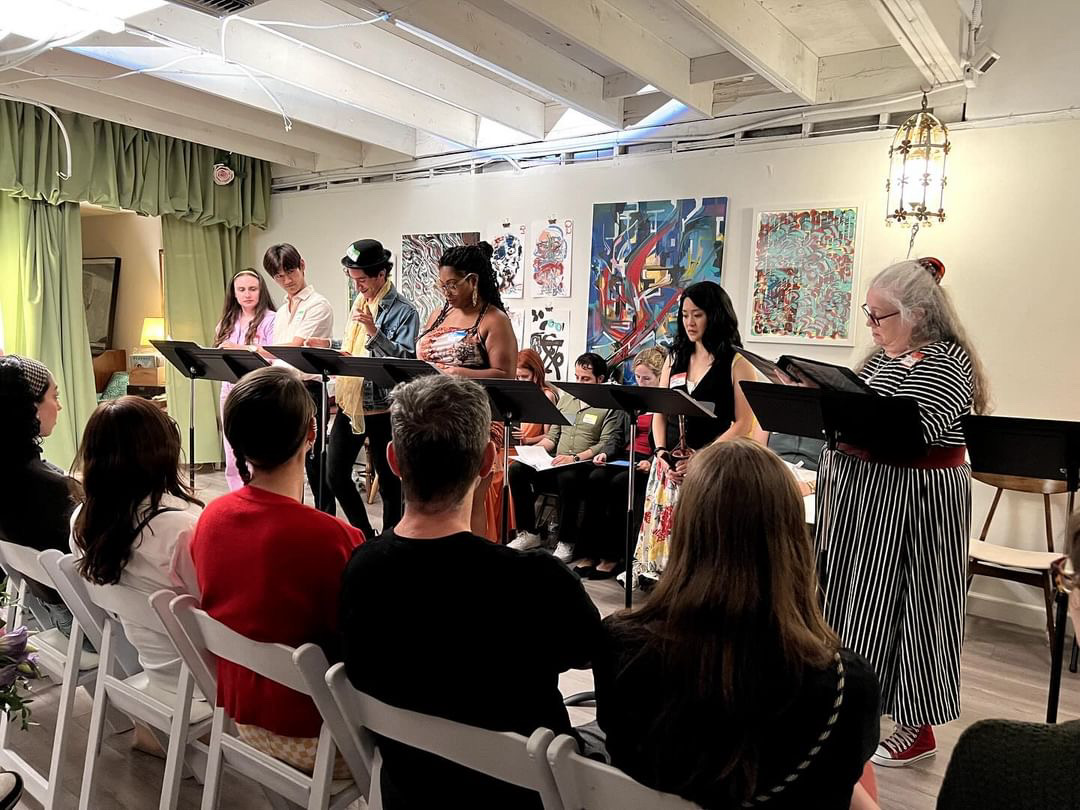
Left to right: Slender (Renée Torchio MacDonald), Shallow (Daniel Kim), The Host/Anne Page (Tiago Santos), Mr. Page (Mikah Kavita), Pistol/John Rugby (Vivi Thai), and Dr. Caius (Debba Rofheart)
The Host and Anne Page as a doublecast was an effective choice, considering how both are centrifuges for the play’s B and C plots respectively — the courting of Anne Page and the rivalry between the French Dr. Caius and the Welsh Parson Evans. Both actors utilized the accent embedded in Shakespeare’s play texts of both these roles — Amanda Noriko Newman capturing the sprite-y, Friar Tuck essence of the Parson perfectly. While I think the ethics of Shax’s “foreign” inclusion in the play are questionable, nonetheless there are countless lines whose delivery are dependent on the accent being performed well if but tongue-in-cheek. More on the gender-swapping, having the heads of the Page and Ford households particularly gender swapped for me not only provided a different accent, I think it subtly raised the play’s central thesis closer to the surface: “What do women want?” This is of course picked up from Chaucer’s Wife of Bath as the top Chaucerian scholar of our age, Marion Turner, points out in her Wife of Bath: a Biography (2023). The sexual ruminations of Mr. Ford as well were demonstrated in a way that lends to a neurodivergent reading (re, OCD) as well — a theoretical (and practical) application gaining traction in Shakespeare today.
While it breaks my heart as a former Latin schoolgirl that Act IV, scene i was cut, I understand why most modern productions, including this one, cut it. If you want a gist of the humor missed, I refer to this clip from Monty Python’s Life of Brian (1979). That being said, my mood was uplifted by the anticipation built up in Act V and of course, the Herne the Hunter at the Oak scene. Falstaff (Booth) with inflatable horns really sums up the motif of cuckold drag and embodiment in an one extent costume accessory. This is a scene that has inspired not only local (to Windsor) cryptozoology, but makes a setup ripe for a Jennifer’s Body or The Craft type setting in a future production. In brief, this 'radically miscast’ reading is actually the ideal setting to enjoy this play. I wish there were more dates for it!
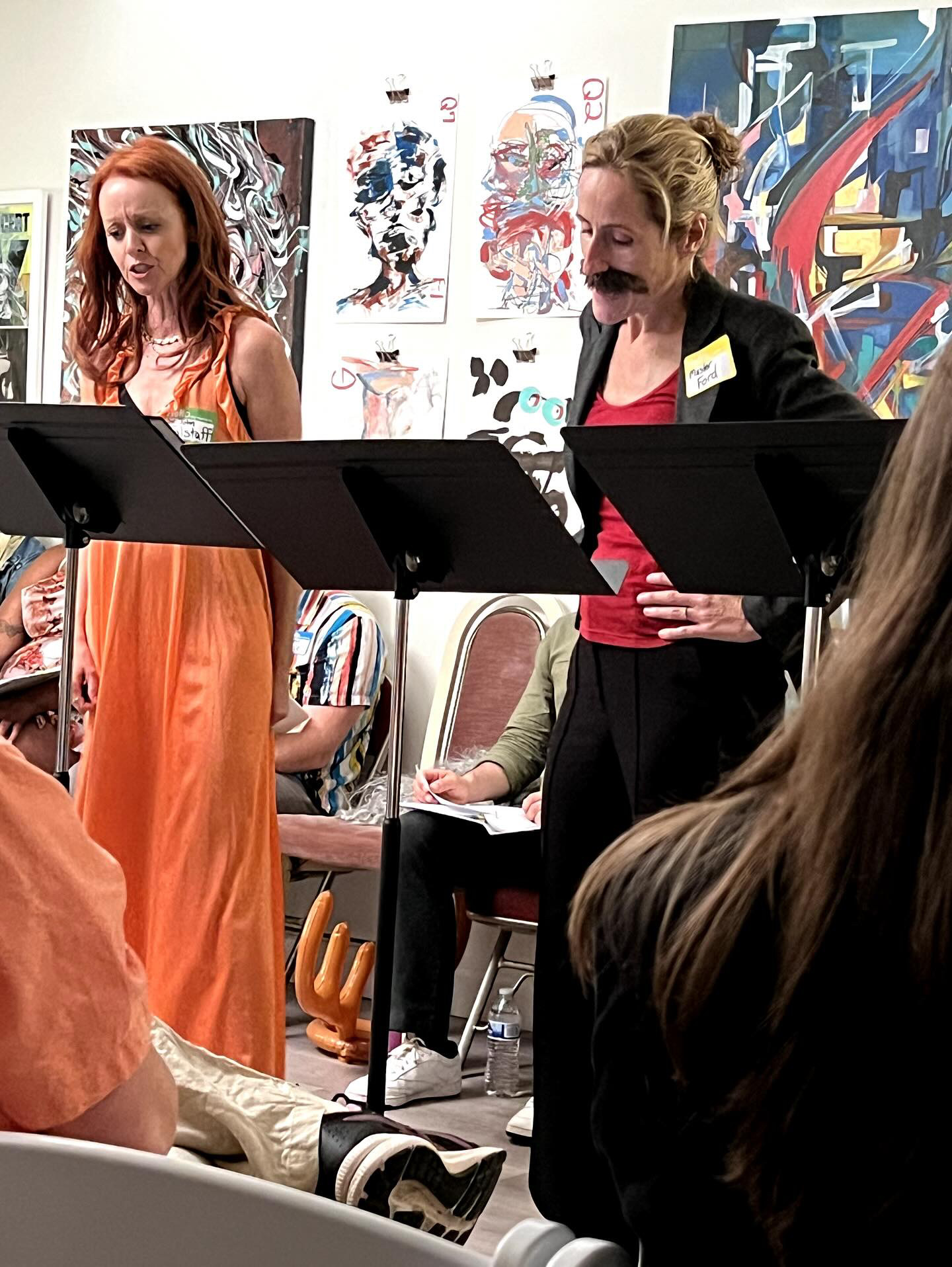
Left to right: Falstaff (Lindy Booth) & Mr. Ford as “Mr. Brook” (Liza Seneca)
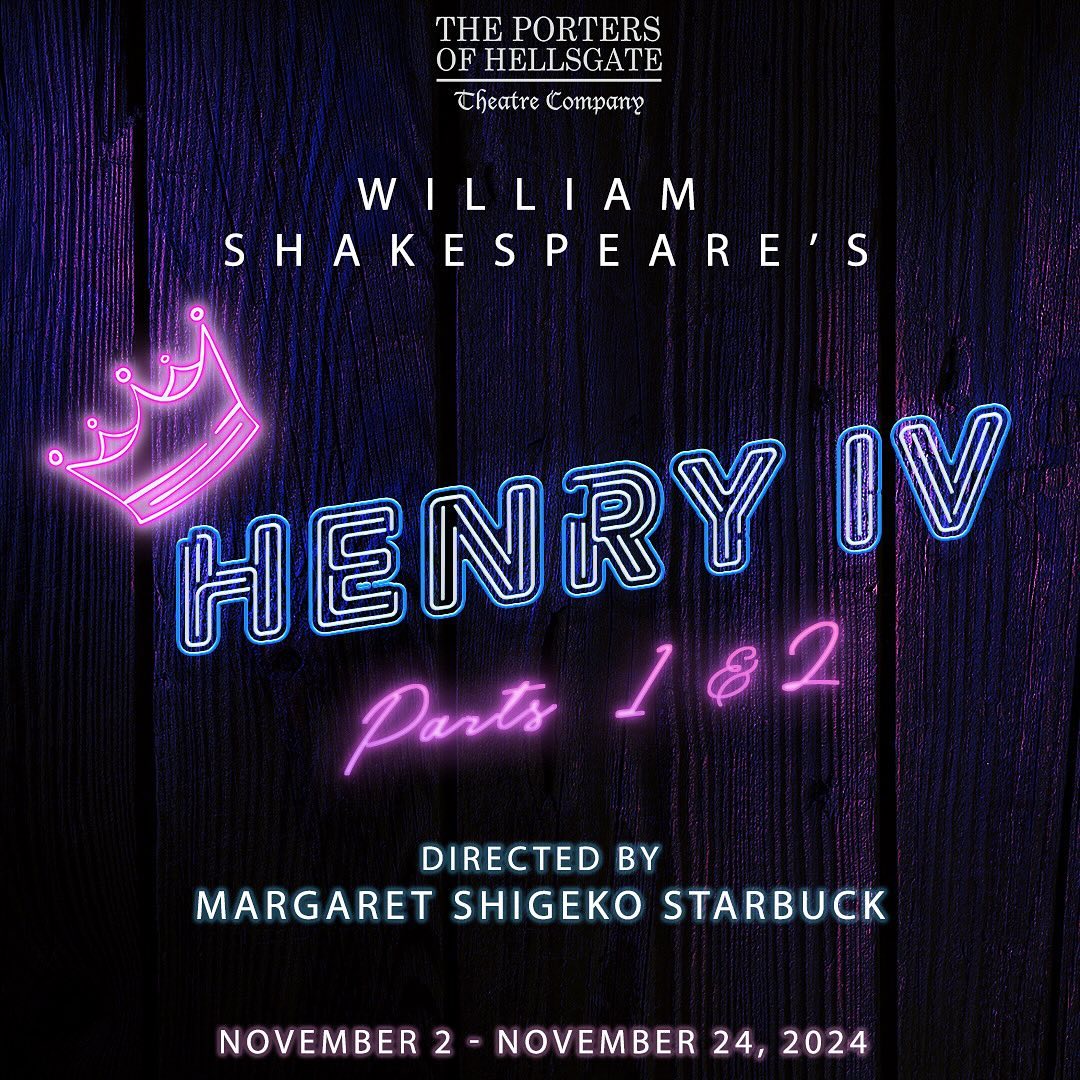
If you’re distraught you missed out and are in the LA area thereabouts, like most readings/performances of Merry Wives, there will be an accompanying Henry IV Parts 1 & 2 produced by the Porters of Hellsgate later this year November 2nd-24th. Please consider going — here’s the flyer:
Additionally, their Season Launch party is September 21st! Looks there will be some refreshments and Shakespeare trivia — maybe I will see you all there?
I’d like to close with also acknowledging I had quite a day before coming to Sherman Oaks to see this play. My beloved community college professor, Kathy Patterson, who instilled the love of Shakespeare in me, was honored at a memorial service in Santa Ana earlier that afternoon. I wrote about her passing in a previous Substack. If you are looking for a way to celebrate, consider donating to a community college scholarship in her honor, at my alma mater Santa Ana College: the Kathy Patterson Legacy Scholarship Fund.