Shakespeare : Some thoughts on 'The Merry Wives of Windsor', in memory of dear friend and mentor Kathy Patterson
Everyone hates on this play because it cares about what women want; Rest in peace to the Summerlands' new queen, Kathy Patterson (1964-2024)

I’m teaching a Shakespeare class this summer, and somehow I got stuck with writing a syllabus too, for the first time! It’s a pleasure and a challenge — trying to balance what I’m comfortable teaching for the first time versus things I have more direct experience teaching if not learning myself. Keeping it to three plays and genre diverse as I could, I picked (taught in reverse order) Troilus & Cressida, Richard III, and to a lot of folks’ chagrin, The Merry Wives of Windsor. I can’t count how many times I’ve been asked a flat “why” towards the last play, but that’s mostly because I’m bad with math. But it’s been a handful of times.
The play has fallen in and out of favor with the academy and the stage both over the years — seeing a peak in the 18th century that saw a steady decline in the Anglosphere. However, there’s a bunch of 20th century German interest in the play, probably due to the mysterious and anonymous “three German devils” mentioned in the second half of the play. Worth noting there is a strong tradition of Italian, French and German libertti written in adaptation of Merry Wives as well — with only one in English from 1929. I can understand the play’s detractors to a point — it’s a weird one. It’s a protogenitor to the city comedies that Jacobean playwrights who-weren’t-Shakespeare (hard to believe, but there were some!) but without the condensed urban debauchery. It is the first time in Shakespeare I have read therein a presence of — for no other term — suburban sprawl. Windsor, after all, would have been closer to a proper suburb of London in the early modern period. That being said, it was no stranger to country estates and an economy semi-dependent on the pilgrimage season. Its twin — Eton — was the center of a Marian shrine popular during the late Middle Ages. Within the city’s own boundaries, the commission of King Edward III, St. George’s Chapel, was well loved by his descedent titularly associated with the fall of the Plantagenet dynasty (and might’ve been happier as a priest), King Henry VI. Both sites would’ve drawn in pilgrims from London and elsewhere in England, and Windsor especially so with royal holiday-goers wanting a good spot to hunt. Almost forgot to mention the House of Windsor, the UK’s ruling (and hopefully last?) dynasty — something something Windsor Castle. Sir John Falstaff — a character whom I can only describe as like John Candy to my friends outside the academy — does a lot of that in the play. Albeit unsuccessfully.
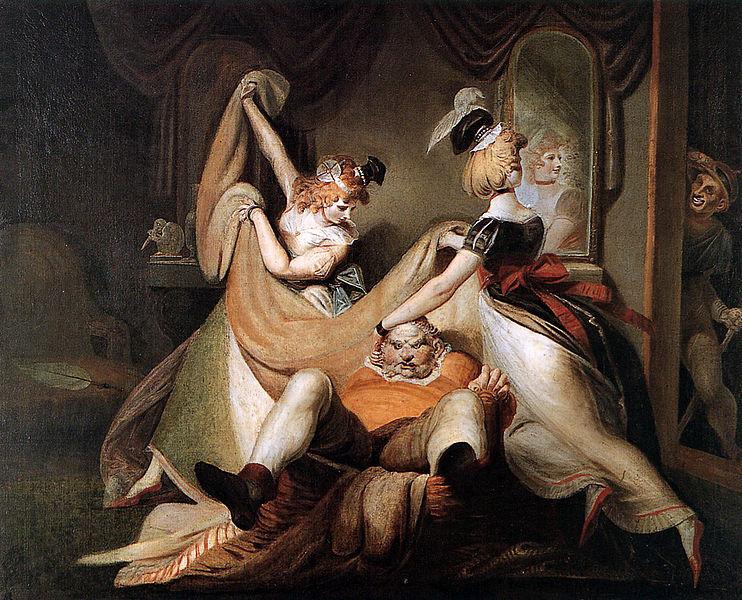
“Falstaff in a Laundry Basket” by Henry Fuseli (1792), public domain
The play revolves him (though eventually decenters him) and its mythos around an apocphryal story from an 18th century source that Queen Elizabeth I loved the Henry IV plays so much (where Falstaff debuts) that she wanted a play about him — in love! <3 And well…he isn’t in love so much as he falls into love. In this case, a ‘buck basket’ of dirty linens from the principal women of the play, Mistress Alice Ford and Mistress Margaret Page to his humilation. A braggadocious figure (a little Braggadocchio from Faerie Queene, Book II anyone?) who loves women and what they have, Sir John Falstaff, is on the hunt for money just as well as women in the play. He’s a broke gentryman with a drinking problem, we all know one. What I find most interesting about the play is the seeming collusion between symbols of fertility and the humilation rituals of cuckoldry and at times, forced feminization. Like a irresistable force versus an immovable object, the two points of tension in the play keep hitting each other until the teleology of the play is challenged with the “existence” of fairies and horned gods. While Midsummer Night’s Dream’s fairies and whimsical nature steal the spotlight of Shakespeare’s comedy, I believe that the fairy scene of Act V with the cacophony of choruses and stage directions circumspect children dressed as fairies at midnight to scare Falstaff ‘straight’ from bothering these ladies again, owes much more to older renditions of fae lore. Much closer to Sir Orfeo’s abduction scene where Heurodis (Eurydice) is tormented, mulitated, and then abducted by fairies than even much of the Faerie Queene itself, or the reception of fairies in the Victorian period and today. For a comedy set in the suburbs, it also deals with the reality that for many of us who grew up in the suburbs, we craved a little bit of Puck or Pan to scare us straight. Something magical (in a territfying sense) to break up the mundane. I hope to talk more about this in some length (ie, a dryer, academic piece) at another point where I’m not traveling for the academy and planning a class simultaneously.
I wanted to open up this piece at least a little bit though with Shakespeare on purpose. Sunday morning I learned that my dear once-upon-a-time community college mentor, English professor of nearly 30 years, and champion for students across the Rancho Santiago Community College District, Kathy Patterson, had passed away from a long battle with lung disease. Typing those words seems so flat, and I feel so numb. I was personally privy to her condition, and have had some time to process what would become her death. And spend time with her the last few years. Instead of being burdened by the usual parade of ‘what-ifs’ and ‘should’ve’s’ that typically haunt me when someone I love passes, so far I’ve been able to channel it into work. Not just any work, but the work she taught me to love. She woke me up from a deep slumber I had in my early 20s where I just simply could not get my fucking shit together. Her community college night lectures on Shakespeare, various traditions of world literature in translation, the Victorian period, and frankly more brought me to the point where I could remember my passion through my education: literature, creative writing, and storytelling.
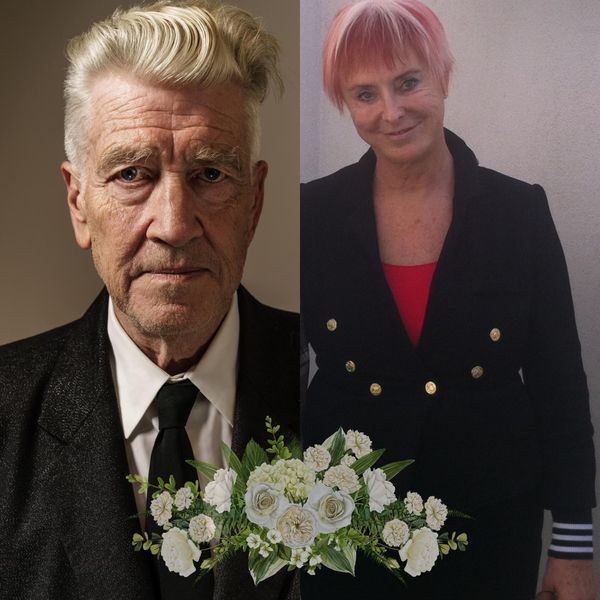
Shamelessly taken from her Facebook page, and I do not know the attribution. But it’s a picture that captures her spirit perfectly. Forgive me.
She was not just an English professor, but the years long head of the Honors Transfer Program at Santa Ana College. I know for a fact she is responsible for the quality education of hundreds if not thousands of SAC students. Many of them going off into other institutions and programs in any trade I can think of. She had so many stories. She was so proud of her students. As an alumna of the program myself, I speak from experience.
—
7pm, any given weeknight and I’m 22 years old. I smell like cigarettes and coffee. I have squeezed in the last bit of the Divine Comedy before lecture. My ex-girlfriend driving me to lecture. Passanger princess I, would not get my license until a few months later. I have another play to finish reading tomorrow morning, for her other lecture. Kathy arrives around the corner in a big, black Hot Topic cardigan and bright, bright, BRIGHT purple hair. You can see it a little bit in the picture but it doesn’t do it justice. As someone who has dyed their hair a lot, it was the true regal violet you dream of having. True Tyrian purple. Like a queen. And then she got to work. Like any great storyteller, she huddled us around her desk and could by memory tell us the reception of any given piece of literature on the syllabus, generation of scholars to the next. From what I recall as well, a triple Gemini.
She was incredibly invested in her students’ education and managed to have a rich personal life; a godmother to many-a-children. It was hard not to be drawn to her and her mission of making literature accessible to her students. I became her student at the exact right time for me, and it was with her good guidance I got into nearly every undergraduate program I applied to. When I got to UCLA, I got to reading exactly where we left off: medieval literature. That is where I find myself now, but the spirit of Shakespeare to me is the spirit of Kathy. Not some dead white dude with musty hair and pencil stache. A gorgeous, eccentric woman who just absolutely lived in her teaching with an alternative bent that would make any “goth” influencer on TikTok shudder. In her bangs, swept by an evening Santa Ana wind, I again and again saw a part of myself. A harbor for weirdo girls like me. I hope to measure to a tenth of her fortitude, if I can even say that much.
There’s nothing at the moment I could urge my audience to do more aside from donating to the SAC Scholarship Program. I hope one day soon, that I can announce other things done in memoriam for her. For the time, I can say that my chapter in the upcoming Marie de Trans: Tranimality, Translation, and Transformation in Marie de France’s Lais will be dedicated to her memory. She was in fact, the first person to introduce me to Marie de France, specifically the lai (don’t ask me to define lai, that’s another Substack post) Bisclavret.
In closing, I will share Sir Alfred Tennyson’s poem written to John Mitchell Kemble, a Beowulf and Old English scholar in the first half of the 19th century — first and last of his kind. I put in bold the words I wish I could say to her.
Sonnet to J. M. K.
Text within this block will maintain its original spacing when publishedMy hope and heart is with thee--thou wilt be
A latter Luther, and a soldier-priest
To scare church-harpies from the master's feast;
Our dusted velvets have much need of thee:T
hou art no Sabbath-drawler of old saws,
Distill'd from some worm-canker'd homily;
But spurr'd at heart with fieriest energy
To embattail and to wall about thy cause
With iron-worded proof, hating to hark
The humming of the drowsy pulpit-drone
Half God's good sabbath, while the worn-out clerk
Brow-beats his desk below. Thou from a throne
Mounted in heaven wilt shoot into the dark
Arrows of lightnings. I will stand and mark.
Enjoy the Summerlands Kathy, I’ll see you there one day.