I Dreamed My Genesis: Dylan Thomas, The Individual, and Creation
"Dylan is about the Individual against the whole creation” — “Is About” by Allen Ginsberg, New Yorker (1996)
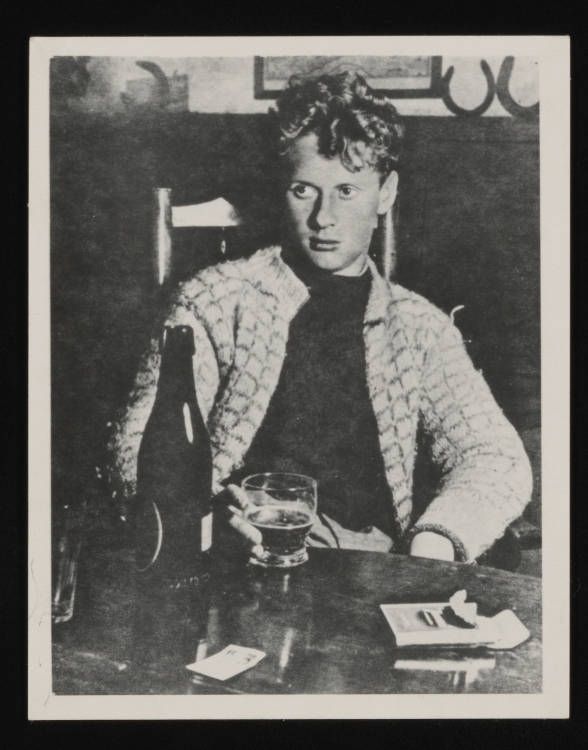
“Bard” first appears in the English lexicon around Middle English, loaning the word from Celtic cognate “bard(d)” that is found across Irish Gaelic, Scottish Gaelic, and Welsh. The word rests as a synonym for poet in most connotations, specifically a poet belonging to some kind of oral tradition. The bardic talents are associated with nonsense, divination, the natural world and serene mysticism that seems to have not been committed to paper. This archaic title has often been used to describe the modernist Welsh poet, Dylan Thomas (1914-1953), whose Collected Poems have been praised as highly as they have been known as dynamically cryptic. In his short career, he contributed to the world of literature, art, and music; he brought immense refocus to the Welsh folk culture, despite never being able to speak Welsh. An admirer of Thomas, the American Beat poetic icon and academic personality Allen Ginsberg, described Thomas’s work as “about the Individual against the whole of creation”. Thomas’s writings often depict archetypes as well as foils of culture as individuals to contrast their disparaging environments and surroundings. Through his modernist dialectics of reevaluating long standing morality and attitudes, Thomas examines the Individual’s relationship to the “whole of creation”, that is, the pressures, communities, and societies that the Individual is enclosed in. Creation’s constraints of birth and death, of voice and silence, and of home and displacement and the Individual’s struggles against them are tackled in Thomas’s endeavors to excavate the Individual from their chains.
Though Thomas’s efforts in literature are widely regarded as hard to decipher, that is not to say he was not able of being more straightforward and accessible. “I have longed to move away”, he wrote as such in the eponymous poem, “From the hissing of the spent lie / And the old terrors’ continual cry” ( Lines 1-3). “Some life, yet unspent, might explode / Out of the old lie burning on the ground, / And, crackling into the air, leave me half-blind” (Lines 12-14). The old lies, here, are drawn up as against the narrator. It is dubious to strike this poem as strictly autobiographical. The analysis of biography often detracts from art and mutes relevance. If bardic verse is associated with anything, it is storytelling, which is not typically autobiographical but often rooted in folklore. The Individual is often at odds with the old lies around him. The acknowledgement of the “generalized other”, according to sociologist George Herbert Mead, then begins to cement around the age of four for most people, when one begins to distinguish between oneself and others. With this, comes the burden of the influence and expectations of others and how they affect one’s life. Oftentimes, the expectations of others are rooted in psychological projections and other biases that do not procure healthy patterns of thinking. The “old lies” of one’s upbringings are among the chief reasons an Individual may wish to “long to move away”, to find spaces, environments, or different stages of life that support them. This is the premise of the Individual versus creation.
One of my favorite albums, John Cale’s Words for the Dying (1992), is a collaboration between Cale, Brian Eno, and a Soviet orchestra putting selected Thomas poems to music. Here’s a trailer for its recent remaster.
In light of Thomas’s passion and profession, the voice, the sacred expressions of the Individual, rests as perhaps the most important facet of the Individual. The Individual stands on his own and presents a nature distinct from the things around him. The Individual is the green leaf among the dead leaves of autumn; the Individual is the star of the starless night. For Thomas’s definition of the Individual’s voice, there is no parallel to the Individual than in “There Was a Saviour”. The biblical allusion is great, but the modernist gospel is greater. “There was a saviour / Rarer than radium, / Commoner than water, crueller than truth;” ( Lines 1-3). The Individual, which is more rare than radium, yet more common the water. Though existing as diametrically opposed to creation, the Individual is a composite image of the whole creation that is around them. The study and experience of creation molds an Individual in such a way, unique to themselves. To express one’s self with your voice is an innumerable challenge; often ignored or rebutted by some aspects of creation, like other Individuals:
Text within this block will maintain its original spacing when publishedThere was glory to hear
In the churches of his tears,
Under his downy arm you sighed as he struck
O you who could not cry
On to the ground when a man died
Put a tear for joy in the unearthly flood
And laid your cheek against a cloud-formed shell:
Now in the dark there is only yourself and myself. (lines 17-24)
The “Saviour” figure in this poem presents us with a recounting of the life of a memorable individual. Though Jesus Christ and his life is an obvious influence here, “There Was a Saviour” is not a carbon copy of the Gospels or particularly salvific. “There was glory to hear / In the churches of his tears” that is to say the passions and love or “tears” the Individual professes are experiences that make life rich. The Individual expresses themselves but so often is met with an audience unrequited. The imagery of “churches of his tears” evokes the memory of large churches and cathedrals, which are at once sacrosanct as well as a place of desolate prayer and mourning.
The syntactical choice of past tense “was” versus “is” in the poem’s title also increases the distance of the poem from the Gospels and other salvific literature in tribute to Jesus Christ (eg, Kahlil Gibran’s Jesus, Son of Man) ; these accounts would more readily declare that “there is a savior” rather than there was one. Though both with Thomas’s saviour as well as Jesus Christ, people tend to ignore and berate people while they are alive and eulogize them after their death. “O you who could not cry / On to the ground when a man died / Put a tear for joy in the unearthly flood”, for in the public reservoirs of grief people can more easily hide and blend in with those who are directly mourning, though they could not cry “on to the ground” when he died. To further illustrate, Thomas writes that “Brave deaths of only ones but never found, / Now see, alone in us, / Our own true strangers' dust”, so that in these passings of great but unsung heroes of one’s life, whether an acquaintance, friend, or celebrity, we see “true strangers’ dust” alone in ourselves; the dust represents the legacy and longstanding effects of their presence in one’s life and how it impacted the development of one’s life. In death, we see both life unlived as well as illusions crumble. Death humbles one to things taken for granted, as one does to the “saviours” in their own life. The voice of the Individual is stifled by creation as being part of creation, speaking to the realms of experience one has with the world. Creation supplies the means for the Individual to pursue his dreams as encompassing all the phenomena one experiences, as well as denying the Individual through the different experiences of challenge, deceit, and other events that inhibit self-actualization.
Creation provides the Individual with the bookends of birth and death, between which the Individual must find a way to combat the limitations of both in one’s life. Those who find sorts of accomplishment, recognition, or influence on others seem to evade such constraints of birth and death in the literal “life long” struggle to fulfill dreams and duties. While death for the Individual marks the end of one’s work, death does not work the same way for creation. Death, in some way brings the Individual back to creation, the “true stranger’s dust” spoken about in “There Was a Saviour”. “And Death Shall Have No Dominion”, one of Thomas’s first published works, tackles mortality in this way.
Text within this block will maintain its original spacing when publishedThough they go mad they shall be sane,
Though they sink through the sea they shall rise again;
Though lovers be lost love shall not;
And death shall have no dominion. (lines 8-11)
Madness, drowning, and the loss of love are typically seen or felt as certain death experiences whether literal or not. But death’s boundaries better define life for the Individual and determines its path. One will either reach death or find life again, to reborn, in these darker ebbs of life. “Though they sink through the sea they shall rise again” holds the implications that one will drown to reborn again or they shall rise to the surface and continue to live. The experiences of living between the World Wars, as well as huge political shifts and wars, definitely seemed to stamp Thomas’s age with death.
Another favorite of mine, “Dylan Thomas” off Better Oblivion Community Center’s self titled concept album (2018)
Thomas breaks down death’s dominion through understanding death does not hold monopoly on these experiences, these experiences become life affirming. Farhi Oz in his paper, “Apotheosis of Mortal Man: Stellar and Terrestrial Imagery in Dylan Thomas’s Poetry”, discusses what he sees as Thomas’s way of edifying and deifying the figures of his stories and poems through “apotheosis”, that is to make mortal subjects into divine subjects of deification usually in a theological context (ie sainthood). In “And Death Shall Have No Dominion”, Oz writes: “Of course, death is never negated totally. Death exists but it can never defeat the life force in nature” (Oz, pg. 1048). Primally, the anxiety of mortality and consciousness that Individuals as human beings receive propels the voice and the need to be heard. The Individual in “There Was a Saviour” rouses the “soft, / Unclenched, armless, silk and rough love that breaks all rocks” in those left behind; in “And Death Shall Have No Dominion” the perished Individual who begot the “true stranger’s dust” is found affirmed as “lovers be lost [though] love shall not”. Though birth and death are the doors that one enters and then exits from life, “true stranger’s dust” enables the Individual to penetrate these obstacles that death. In this struggle between the Individual and creation, Thomas champions the Individual’s ability to live through death vicariously through the influence one creates.
The environments that creation places the Individual in by circumstance, like a birthplace, invariably challenges the Individual to rise above the conditions. The whole of creation, to the Individual, is the otherness from the Individual is emphatically separated from but also what he longs to move away from. Creation is what surrounds the Individual, but yet what is the Individual? It is not difficult to delineate between two different people standing next to each other. Yet, the whole of creation is not just simply different people. The scope of whole of the creation extends to far more than other individuals. “When I Woke” demonstrates how even the morning exists as a generalized other:
Text within this block will maintain its original spacing when publishedEvery morning I make,
God in bed, good and bad,
After a water-face walk;
The death-stagged scatter-breath
Mammoth and sparrowfall
Everybody’s earth.
Where birds ride like leaves and boats like ducks
I heard, this morning, waking,
Crossly out of the town noises
A voice in the erected air,
No prophet-progeny of mine,
Cry my sea town was breaking.
No Time, spoke the clocks, no God, rang the bells,
I drew the white sheet over the islands
And the coins on my eyelids sang like shells. (lines 16-30)
The morning is not just simply the morning one experiences. The morning for the Individual is also the “death-stagged scatter-breath” after “a water-face walk”, that is to say, washing your face and the musk of morning breath. This is another part of the whole creation, “everybody’s earth”. Individuals are subject to all of the aspects of every morning, each and every morning; the start of one’s involvement with creation. The whole of creation enables itself by subjecting the Individual to such conditions. “Mammoth and sparrowfell”; the alpha and omega binary Jesus gave in the Book of Revelations (1:8, 22:13). Thomas is not above (or beneath) biblical allusion, but he contours these allusions in his own image — the act of “dreaming his genesis”. But in fact here, the Individual rejects the whole of creation while creation denies him of his will.
Over the noises and cries of the morning in this sea town, the Individual draws the white sheets of the duvet over themselves and the coins on their eyelids brings the weight of sleep back. In a long and drawn out way, this is the lament of every Individual unwillingly to face the day. The classical Greek allusions, of coins on the eyelids, allude to the Greek burial practice of leaving coins on the eyelids of the deceased. In this way, the departed are seen to have been given fare to cross the eternal river Styx that leads to the underworlds. The white sheet, throughout many cultures, is also associated with the dead and death. Creation, evenly minutely, strikes down individuality here. Though the facets morning have no direct interest or imposition against the Individual; yet the exact nature of being outside the Individual brings them to the rejection of it. These small deaths constitute the life and proliferation of the Individual. These struggles define the Individual and properly set apart from his toxic but undeniable relationship to the whole of creation.
Thomas, a modernist poet concerned with where life begins and ends, feeling silenced and then being heard, and feeling at home in one’s own skin, was a natural product of the British suppression of Welsh culture, language, and values. But Thomas is not Wales and these Individuals are not Welsh. The dynamic and struggle between the Individual and creation is a universal paradigm. In the twentieth century in particular, the Individual came under fire with the world’s political events such as the rise and fall of fascism in his lifetime, the subsequent wars preceding and succeeding them, genocides, and eventually the possibility of nuclear destruction. These events helped to shape the modernist dialectics of moral re-evaluation that lead to the creation of many great modernist works of literary output, of which Thomas participated in. At the moment we find ourselves in history, putting these socio-political influences atop of our own may continue to unlock Thomas’s cryptic poetry.
As profound as Thomas articulates himself through his work, the notions of saviors and martyrdom, growing up from your surroundings, the lament of death and even simply getting out of bed to face the day are not things one is unfamiliar with in an average life. But Thomas manages to bleach and neutralize these solutions of character in something challenging yet palatable in these beautiful, dark rhythms. For Thomas and people anywhere trying to make a statement and accomplish a dream, so often it seems that the whole of creation stands in the way of an individual’s will. In these curious and modernist investigations, Thomas digs deep into the individual psyche and one’s means against the seemingly bitter, wide, yet captivating and inspiring world that all phenomena is birthed from.
Lastly, not a Thomas related work, but a favorite Welsh folk song of mine that reminds me of Thomas and his legacy
Works Cited
Battersby, Eileen. “Dylan Thomas and so Much More – a St David’s Day Salute to Welsh Writers.” The Irish Times, The Irish Times, 1 Mar. 2015, www.irishtimes.com/culture/books/dylan-thomas-and-so-much-more-a-st-david-s-day-salute-to-welsh-writers-1.2121616.
Öz, Fahri. “Apotheosis of Mortal Man: Stellar and Terrestrial Imagery in Dylan Thomas’s Poetry.” Gaziantep University Journal of Social Sciences, 2016, pp. 1044–1053., doi:10.21547/jss.265483.
Niskanen, Paul. "The Poetics of Adam: The Creation of םדא in the Image of םיהלא
." Journal of Biblical Literature, vol. 128, no. 3, Fall 2009, pp. 417-436. EBSCOhost, search.ebscohost.com/login.aspx?direct=true&db=a9h&AN=44339356&site=ehost-live.
Ginsberg, Allen. “Is About.” The New Yorker, The New Yorker, 21 Oct. 1996, www.newyorker.com/magazine/1996/10/21/is-about.
Osborne, R.G. "Death Revisited; Death Revised. The Death of the Artist in Archaic and Classical Greece." Art History, vol. 11, no. 1, Mar. 1988, p. 1. EBSCOhost, search.ebscohost.com/login.aspx?direct=true&db=a9h&AN=7355577&site=ehost-live.
Macklin, Christopher. "Cross-Cultural Perspectives on Secular Vocal Performance in Early Wales." Journal of the Royal Musical Association, vol. 134, no. 2, Sept. 2009, pp. 167-183. EBSCOhost, doi:10.1080/02690400903109059.
Holbrook, David. Dylan Thomas and Poetic Dissociation. Southern Illinois Univ. Pr., 1967
Mead, George Herbert., et al. Mind, Self & Society: the Definitive Edition. University of Chicago Press, 2015.
Steloff, Frances. "Dylan Thomas." Journal of Modern Literature, vol. 4, no. 4, Apr. 1975, p. 864. EBSCOhost, search.ebscohost.com/login.aspx?direct=true&db=a9h&AN=6914349&site=ehost-live.