Time Before Time: a brief introduction to Bionicle & the Medieval
A new study in Anglo-Danish cultural transmissions but mostly musings and memoir (I need to get better at stop motion animation...)
Hællœ everybodiė — that’s definitely not how you say ‘hello everyone’ in Old English.
Coming off the New Chaucer Society congress in Pasadena, I’ve been thinking a lot about how to bring in new ‘texts’ (contemporary media broadly) in conversation with old ‘texts’; (pieces in the literary tradition like Beowulf). Drawing not only comparisons but discussing the direct ‘literary DNA’ shared between texts like The Nun’s Priest’s Tale and Chicken Run (2000) or Christine de Pizan’s Book of the City of Ladies and Barbie (2023). Choose-your-own-adventure but the options are stripped from the plotlines of the worst Middle English romances. I could go on — but I don’t want to give all my article ideas away.
It is undeniable that we are in a new hauntological age — after a drawn out reception of the “Long 1980’s”, augmented by series like Stranger Things, music like the 1975, and the universal queer mullet of the late 2010’s. The 1990s and y2k nostalgia is out in full swing, and as someone born in 1996, my childhood memories constantly jettison between the two decades as though as they are two parents fighting over custody. I am not a child of divorce, and I don’t meant to steal valor from those who are!
—
My first day of Kindergarten, to my recollection, was 9/11. Not that I had any idea what that meant at the time — I just remember adults being a little more panicked than usual. For me though, unable to understand what the political ramifications were to mean for a five year old, I was just anxious to receive the LEGO magazine on time. LEGO was a huge thing in my household, given its mainstay as a unifying toy of the 1990s and early 2000s. My Swedish-American household I’m sure could have stood to make more jokes about Danes in light of that, but my parents held back as the Star Wars ships, random castles and fire engines populated table after table. Maybe one day I’ll open up about my first ER visit at 3 years old when I stuck a LEGO up my nose (it was very small).
When the LEGO magazine came in the summer through that fall, it was different than before. There would be a cellophane wrapper — and another quire of glossy paper on the side. They were the first Bionicle comic books.
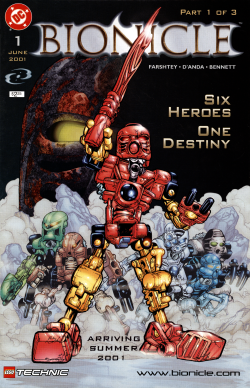
Copyright DC & LEGO; qualifies as fair use under United States copyright law.
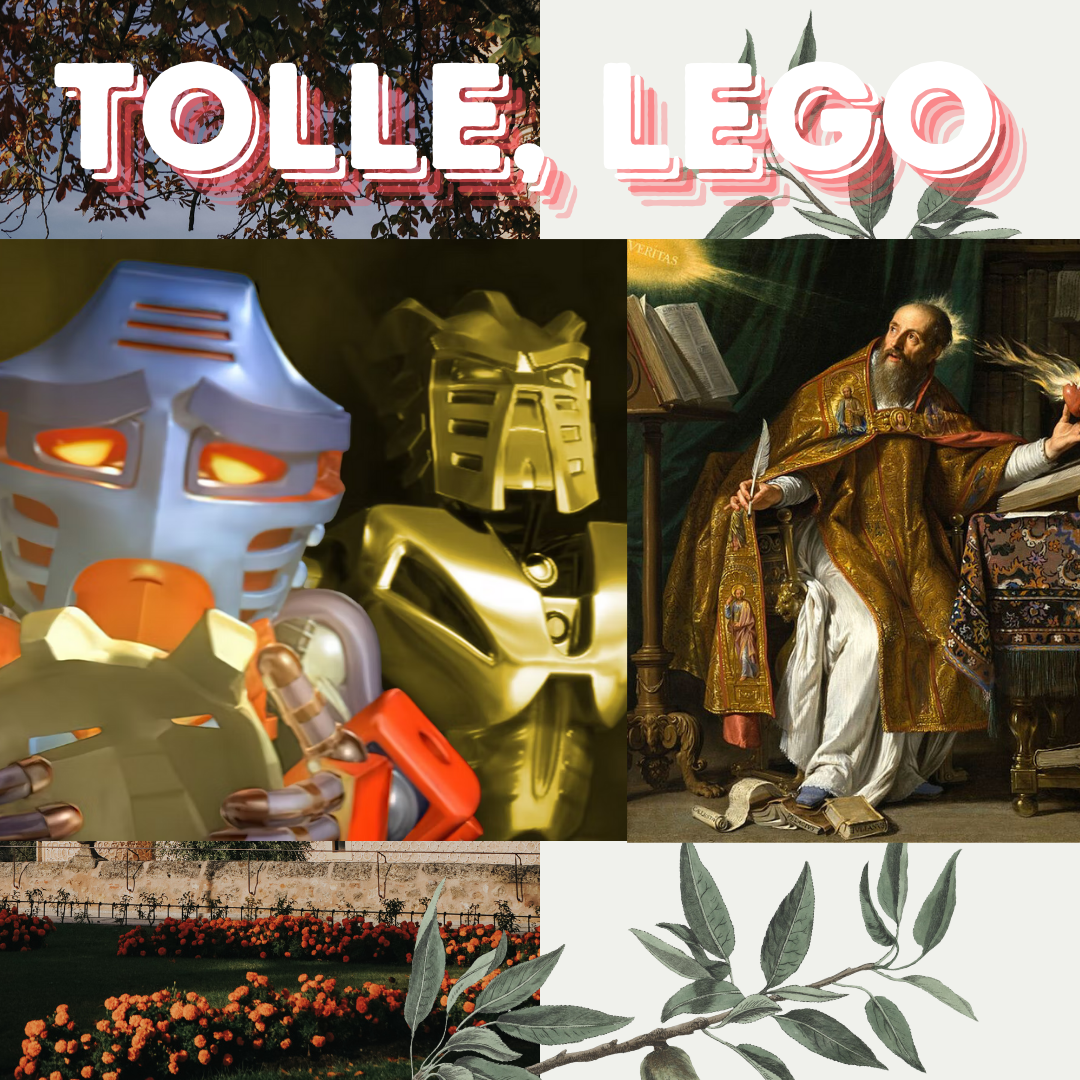
I can taste it — those moments. Like a new car smell or the eau de parfum lingering in every Barnes & Noble. It was the first time that I can remember an iconic storyline - represented by one physical document/series of — and screamed out “Tolle, Legge” (‘pick up and read’). Like St. Augustine’s conversion moment, Bionicle was the first franchise from its beginning, for my hybrid millennial/Gen Z upbringing, to introduce itself as a kind of literary object to me. My AuDHD self was immersed in the worlds of Thomas the Tank Engine, Winnie the Pooh, and Power Rangers as well, but none of them were started during my lifetime. Shakedown 1996 or whatever (thanks Billy Corgan).
Copyright Miramax, under qualifies as fair use under United States copyright law; Saint Augustine by Philippe de Champaigne held by Los Angeles County Museum of Art (public domain)
The mystique and mythos of Bionicle was unmistakable from its inception. It was also not created perfectly — I do not want my nostalgia goggles to sideline the important indigenous reading and resistance to the early Bionicle series when the creative team quite literally appropriated cultural/linguistic l terms from the Māori people. However, it appears there were reperations early on in an out of court settelement after legal challenges from Māori tribes. Since this initial policy, the names and onomastic construction of the Bionicle unvierse has sourced from a variety of languages — including but not limited to Rotuman, Latin, Greek, Swedish, Danish, Finnish, Celtic languages, and Japanese.
For me as a medievalist and English literature scholar, it’s also worth noting that BS01 Wiki (which I am going to be consulting constantly for the next few months) cites the Old English weak class 1 verb læcan (‘to move quickly’, ‘to flicker’) as the etymological source for Lhikan — the ‘titan’ Toa Mangai of Fire as featured in the Legends of Metru Nui film. This is not the source for my interest in writing about Bionicle and medievalisms — but it is a link to ground this project. I’ve realized lately, again, not only how wide medievalism, adaptations, and memoir can all co-exist in writing about the Middle Ages, but how far the creative-critical can go to meld interests: the personal with the academic.
I intend in this series, the first of its kind and my first official ‘series’ on my Substack, to bring Bionicle in conversation with medieval literature and history — particularly the Old English tradition. But I can already envision other spinouts and spinoffs, and I hope I can my colleagues and the Bionicle fandom talking more deeply! I of course will have to paywall some of these (for a time).
Next week, I will start off with close readings of some of my own Beowulf translations conjunct the Bionicle universe.