The Knight's Wail: Homosociality in King Richard II's Courts, Conclusions
Thanks for playing!
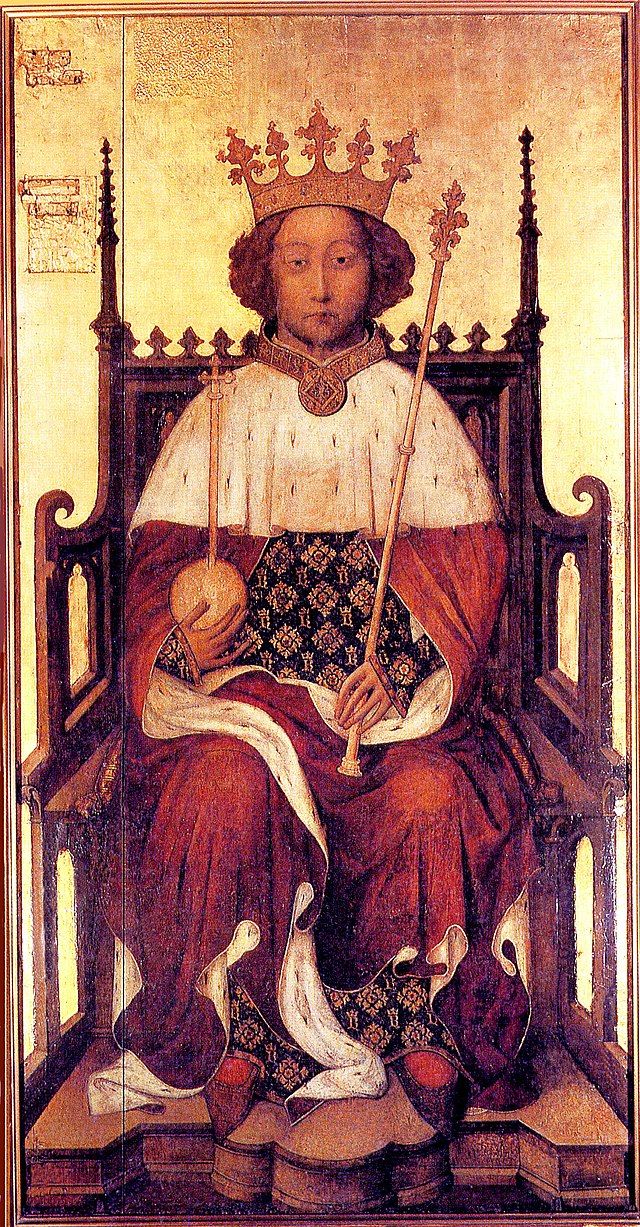
Nearly two centuries and one dynasty after the reign of England’s King Richard II had ended, celebrated Tudor playwright, poet, and latent propagandist William Shakespeare wrote an eponymous history play concerning the downfall of this curious king. In the first act and scene, some gentle and ironic foreshadowing is given by his successor Henry IV (then known as Henry Bolingbroke) in a flowery opening statement for an appeal against Thomas Mowbray, Duke of Norfolk, in the court of King Richard:
Text within this block will maintain its original spacing when publishedFirst, heaven be the record to my speech!
In the devotion of a subject’s love,
Tendering the precious safety of my prince,
And free from other misbegotten hate,
Come I appellant to this princely presence.
(I.i. 30-4)
Beyond being an oddly courteous way to begin a lay of bold accusations against the Duke of Norfolk such as “a traitor and a miscreant” (39), the relatively gentle tone of Bolingbroke here is exemplary of the Ricardian court en masse: a raging underbelly of tension between men vying for power held together by the necessity of Richard’s divine rights. For historians, his reign is characterized by unconventional, feminine, and once-in-a-dynasty sort of behavior. His reign by the supplantations of regency councils, the tumult of Peasants’ Revolt in 1381, and the testosterone-fuelled scandals of the Lords Appellant, and lastly the coup d’etat performed by his cousin Henry Bolingbroke.
The scope of this argument was to demonstrate the wide range of questions regarding masculinity in the court of King Richard II. The source materials for research, ranging from online legal archives, chronicles in both Latin and English, and Middle English poetry was often a jarring jump between methodologies all but regularly converged on the same point: Richard’s reign marks the end of not only the Plantagenet dynasty, but so many of the conventions of masculinity that Anglo-Norman society took for granted during its first three hundred years of rule in England and the areas its dominion would bleed out into; invariably including Wales and parts of Ireland. It is these questions, highlighted by the media written as reception to the court such as the contemporary chronicles and poetry at the time (plus Tudor pieces like Shakespeare’s Richard II), that allowed for the decades’ tension in the court to culminate in Bolingbroke’s usurping of the throne, which in fact as noted by McVitty’s volume, would bring rise to the questions of legitimacy — the direct power instability that would divide the Yorkist and Lancastrist factions in the War of the Roses. Richard II’s dependence on his homosocial bonds often go overstated as the men that surrounded him were often just as dependent on their bonds with him.