The Knight's Wail: Homosociality in King Richard II's Courts, in Chronicles & Poetry (Robert de Vere & the Lords Appellant Crisis)
Fellas, is it gay to give titles to your bros?
Hi everyone! Back to the biography of Richard II’s court that nobody asked for! Hoping to pump out another Bionicle article soon, but it’s been hard juggling teaching + recovering from COVID and other writing deadlines. I have not forgotten what you’re really here for!
If you missed the first part of the article series, here it is.
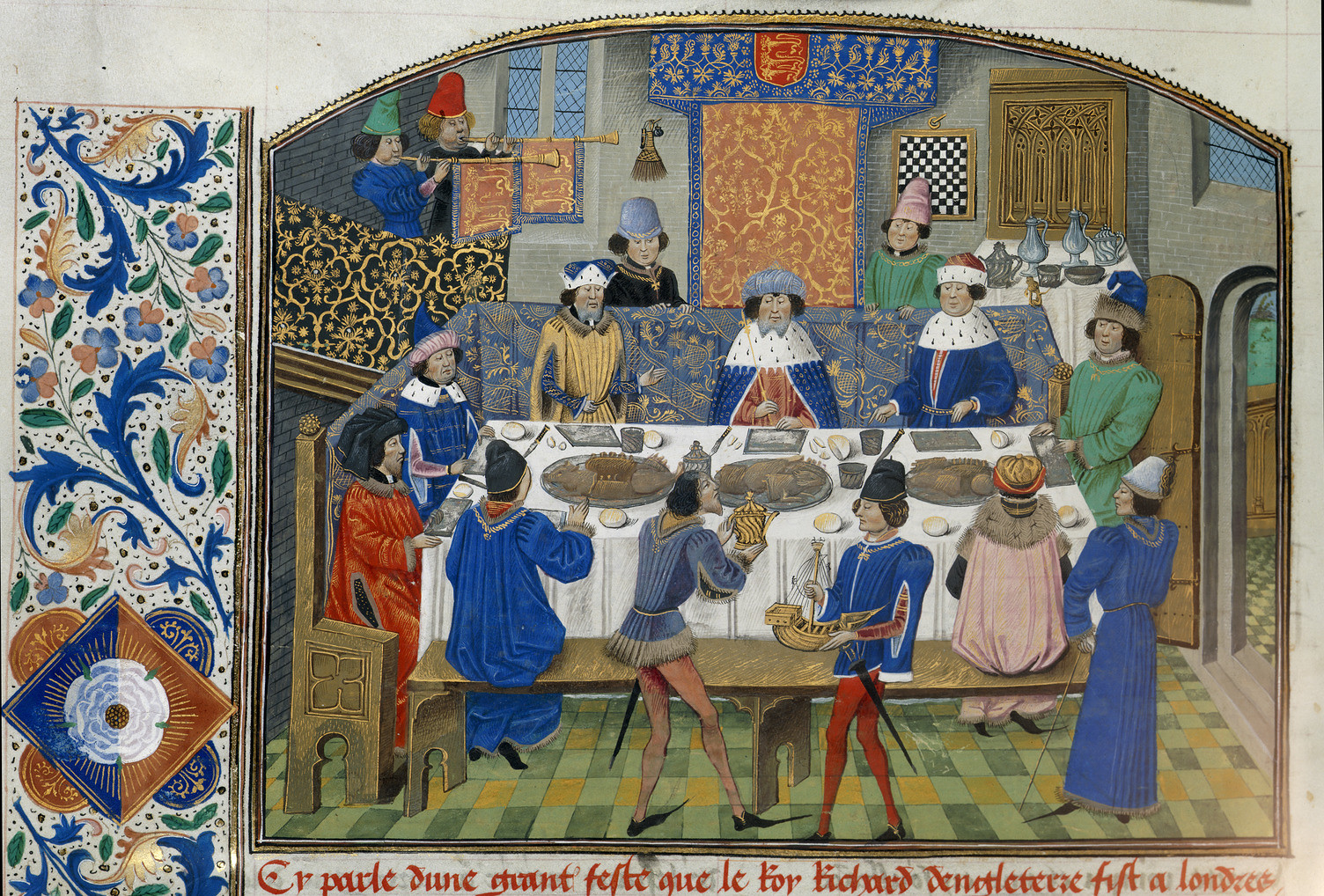
Chronique d' Angleterre (Volume III) - caption: 'Richard II dines with dukes', Royal 14 E. IV, f.265v (Courtesy of British Library)
Robert de Vere, Lords Appellant
The peasants of East Anglia and beyond, as mentioned, were not the only contingent group in England during Richard’s reign that felt irk towards the status quo being procured. After John of Gaunt’s departure for Castille, Richard had been free to populate his circle with titles as he saw fit without his ambitious uncle’s input and years since without any regency councils (whose structure and membership anyway has been inconsistently defined1) during his minority. One of Richard’s closest confidants during this time, his friend Robert de Vere, was gifted titles usually reserved for princes and unusual to be given to a man of court such as an Earl of Oxford. He was made the one and only Duke of Ireland (the title went extinct after him) in 1386 the same year he was made Justice of two distinct jurisdictions, Chester then North Wales (Saul, 172). This fell under behavior wayward or otherwise contrary to the administrative traditions of his predecessors, though that is not to say that certain heads of the House of Plantagenet were not privy to corruption and bestowing titles, offices, or lands to friends. From this instance and others, including Richard’s begrudgement of Wonderful Parliament’s impeachment of Chancellor Michael de la Pole, frustration besmirched other more established, older nobles. This included (but not limited to) one of his uncles, Thomas Woodstock, Duke of Gloucester in tow with Thomas de Beauchamp, Earl of Warwick, and Richard FitzAlan, Earl of Arundel and Surrey. This group of five, with the subsequent inclusion of Richard II’s first cousin Henry Bolingbroke (later King Henry IV) and Thomas Mowbray, Earl of Nottingham, would put the questions of knighthood and kingship on trial and steer a good half of Richard’s reign.
While Richard tried to utilize de Vere’s role as Justice as a means to build royalist power in the northwest of the country in late 1387, the first blow from the Lords Appellant was delivered in the defeat of de Vere and a royalist militia at Radcot Bridge outside Oxfordshire. Upon the arrival of Bolingbroke and the forces he mustered, de Vere announced to his men he was fleeing the country and according to Walsingham, his men “cursed his cowardice, and prepared to make their submission to the lords” (Walsingham, 838-9). Analogous to Wat Tyler’s swift and fatal casualty at Mile’s End by a squire of the manor, Cheshire’s constable Thomas Molyneux died in a vain bid to preserve the masculine image of knighthood and chivalry, with famous last words of “‘If this must be, then allow me to come out and fight with you, or any other of your men, that I may die like a man’” (838-9), before being stabbed in the cranium by Arundel’s stewart, Thomas Mortimer. Molyneux’s death is notable not only in its brutality but in that he is the exception to the rule of men in authoritative and legal roles “dying like a man”, especially those who fought for and on the side of King Richard. However, even in death homosociality persists in the Ricardian court; in its rituals and material affects.
Robert de Vere, among other allies of King Richard during the Lords Appellant uprising, was able to flee England and die in exile, but nonetheless Richard and de Vere’s homosocial affection persisted posthumously. Just three years after de Vere’s death in 1395, at Richard’s bequeath his embalmed corpse and coffin were received by the king from their point of origin in Louvain, where de Vere was to be reburied at Earls Colne in Essex, the family estate of de Vere’s lineage since the days of William the Conqueror2. He got a chance to look at his friend’s face a final time albeit embalmed, demanding the coffin to be unsealed and cast open. Given the intensity and stake in the friendship it is unsurprising that Richard may have sought closure in a such way, but de Vere was not the only friend of the king or crown to experience this treatment and Richard’s insistence at extravagrent burial exists as another idiosyncrasy of his reign. Richard forgoed both the last wishes of Bishop of Salisbury and Lord High Treasurer John Waltham, notable Anglo-Italian mercenary Sir John Hawkwood, Sir John Golafre and Archbishop Courtney3, by interning the former three in Westminster Abbey after their initial burial, and the latter in Canterbury Cathedral where he once held the highest ranking ecclesiastical office in the Kingdom of England. This tendency of Richard would actually win him the criticism and detractions of chroniclers at the time such as Thomas Walsingham, whose contributions to St. Albans Chronicles during the Ricardian era would not only chide Richard, but provide definitions and conservative attitudes towards masculinity and its function in the court of King Richard II. The Lords Appellants’ take over of the court after de Vere’s retreat into exile, however, would not solve the crisis at hand.
Lepine, David. “Cathedrals and Charity: Almsgiving at English Secular Cathedrals in the Later Middle Ages.” The English Historical Review, vol. 126, no. 522, Oxford University Press, 2011, pp. 1066–96, http://www.jstor.org/stable/41238872.
McHardy, A. K., editor. The Reign of Richard II: From Minority to Tyranny 1377-97. Manchester University Press ; Distributed exclusively in the USA by Palgrave Macmillan, 2012, p. 32. ↩
“Earls Colne: Introduction.” British History Online, Victoria County History, https://www.british-history.ac.uk/vch/essex/vol10/pp86-92#fnn110. ↩
Saul, Nigel. “17. Richard: King and Man”. Richard II. Yale University Press, 1997, p. 461. ↩