The Knight's Wail: Homosociality in King Richard II's Courts: The Chronicles
Chroniclers always have the real tea
The Chronicles
Coinciding with the explosion of English verse and royal patronage during Richard’s peak, the significant chronicles of his age were being translated into English and writing considerably more on English issues contemporary to their time. A generation before, Ranulf Higden’s Polychronicon set a relatively high bar for the chroniclers that proceeded with an impressive corpus that spans nine volumes of the Rolls Series1. Two Middle English translations of the Latinate text were written under Richard’s reign, a massive feat then as it would be now (as no Modern English translation stands). This mammoth chronicle would play a definite influence on the Welsh academic Adam de Usk, who wrote chronicles throughout his life and none particularly favorable towards Richard. Upon seeing Richard’s casket, he still held nothing but contempt: “My God! How many thousand marks he spent on burial-places of vain glory, for himself and his wives, among the kings at Westminster. But Fortune ordered it otherwise” (Thompson, 205). The use of “wives'' here may be emphatic, as Queen Anne had died in 1394 while Richard’s second wife Isabelle outlived him. A euphemistic reading would give a begrudging reference to opulence and extravagance (ie, presence of lovers), and if nothing else a continued assault on his character post mortem2, which would coincide with the aforementioned Walsingham and de Usk both, they attack Richard for being vain and self-absorbed while presenting to the reader small foils for which he is compared to. The Archbishop of Canterbury (and one time Chancellor) William Courtney, is referred to by Usk as “ille vir perfectissimus” (Thompson, 8, emphasis mine) for his confrontation with Richard over his choice of counsel as well as supposition of new taxes. The latter especially was a wildly unpopular move in the light of the Peasants’ Revolt of 1381, partially induced by the peasntry’s reaction from levy taxes.
Courtney’s criticism (and Usk’s praise) would mark neither the last time Richard would have the company he kept challenged, nor the first time in English history that tension between archbishop and king specifically disturbed the dynamics of the court. The archbishop-king relationship was a notable one in the Plantagenet dynasty of course, with the tumultuous and violent end of Henry II and Thomas Becket’s friendship, landing the latter in an extrajudical murder plot. It also would, however, result in his canonization3. Becket’s relics were ordered to be moved out of Canterbury to Dover shortly after the falling out of Courtney and Richard, which according to Saul in Richard II was prevented by the cathedral’s monastic community4. What Usk spells out in his Chronicon is not only that Richard was an ill-fitted leader but one who had repeated the patterns of king past — sacreligious to Archbishop Becket in death as Henry II in life.
Usk’s evaluation of men before Richard does not end with the altogether brief discussion of Courtney, but naturally turns also to his most significant uncle, John of Gaunt, Duke of Lancaster. Usk in his Chronicon constructs a rather romantic (though not entirely of ‘rose tinted glasses’) view of John of Gaunt as he does of knighthood:
The duke of Lancaster also, claiming the kingdom of Spain in right of his wife, sailed to that country two years after, with another crusade ; and there he lost by the same sickness many of the nobles of the realm of England, and, I may say, the flower of its youthful chivalry. Yet he made peace with the king of Spain, receiving a duchy for the term of his life, and a large sum of
gold for his outlay, and giving his daughter in marriage to the king's eldest son ; and so he returned to England (Thomspon, 147)
Gaunt’s arc as claimant to the office of King of Castille is indicative of the image of the knight in wane. Cultural analogies like ‘crusade’ here should not go understated — his attempt to rule Castille was just as tangential as his rule of England was: partial at best. Like so many crusaders before him, Gaunt left Spain without another title despite Usk’s insistence, him likely bolstering Gaunt’s own legacy. Footnotes by Thompson indicate no duchy is referenced by “other chronicles [...] By the terms of the treaty, Catherine of Lancaster [Gaunt’s daughter] married Henry, prince of the Asturias, in 1393. The Duke received the sum of 200,000 crowns and a pension for the lives of himself and his duchess” (147). His nephew Richard, though, would bestow the Duchy of Aquitaine after the climax (but not final act) of homosocial tension in Richard’s court in the Lord Appellant's controversy. John of Gaunt plays a Holy Land crusader like a Knight chess piece across Britain, France, the Low Countries, and Iberia, and yet the only substantive continental title he held was given expressly through the social mechanism of homosocial relationship between him and his nephew — not a particularly easy one to navigate and marred by conspiracy over the twenty years of Richard’s reign. In the absence of a ‘functional’ Plantagenet court, homosociality stands in as a deus ex machina; a mechanism by which titles are simply procured on the grounds of homosocial affect and bonds. The stripping of titles and lands as well, became an important dynamic of the court towards the end of Richard’s reign. Usk, however, is far from the last contemporary source to scorn Richard and praise members of his regency council.
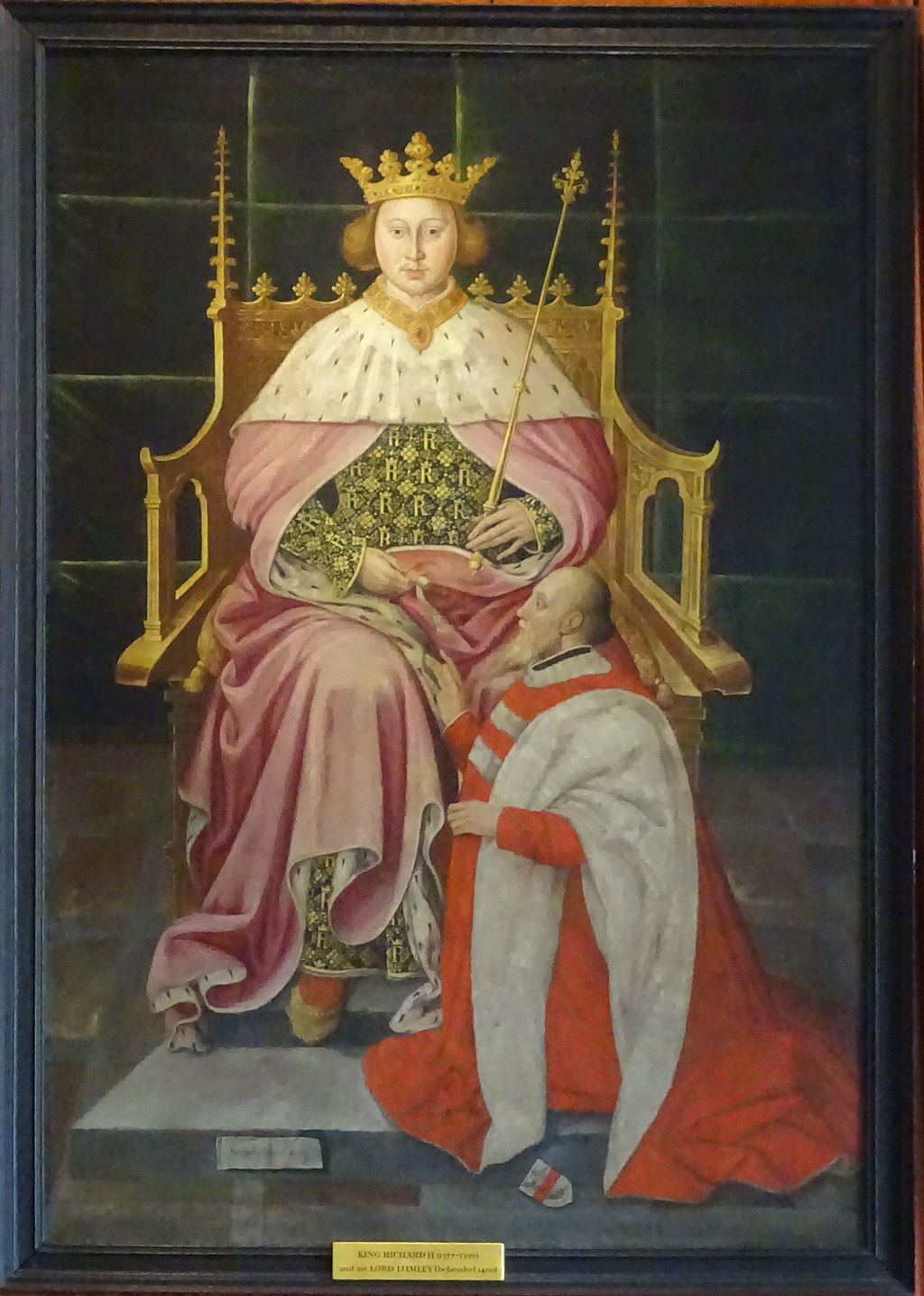
Creative Commons License: © Ad Meskens / Wikimedia Commons
Anoniem, Koning Richard II (1377-1399) en Lord Ralph de Lumley, 1st Baron Lumley (onthoofd) - in Leeds Castle, Maidstone, Kent, UK.
From de Usk’s more well known contemporary, Thomas Walsingham’s extant criticisms of King Richard and his court are all the more damning, and provides a gendered framing that Usk does not employ. Contributing to the longstanding series of the St. Albans Chronicles, Walsingham writes during and after Richard’s rule. In his Chronica Maiora, he refers to knights in Richard’s court as “effeminati” in three separate instances5. While a contemporary lens of ‘effeminate’ could read as queer, Ormrod in “Knights of Venus” contends that rather: “The use of explicitly gendered adjectival forms in these contexts suggests that the notion of the 'effeminate' was deployed by Walsingham mainly as a means of generalized social criticism and was not intended to carry any particular sexual connotations” (Ormrod, 295). I would also add that the application of contemporary queer theory and terminology to the Middle Ages is sometimes damaging or at least not applicable, while certainly a spectrum of gender and sexuality can be constructed from primary sources of these lives and times.
What is clear from Walsingham is his characterization of what a court should be, what a knight should be, is a conservative one, and Richard fell short of his immediate predecessors in that respect. Walsingham also makes note of his disapproval of stratagem executed by the court as they languished in the chronicle as “foolish”6 and pitted against the interests of his uncles, including of course but not limited to John of Gaunt. Walsingham makes record of discord between the two, in the heat of an English invasion of Scotland. He cites Gaunt, “greatest among the magnates” (Taylor et al, 763) as calmly and methodologically suggesting to advance by way of an estuary of the Scottish river Forth, a piece of advice not taken well or at all by Richard. Still, the most striking scene in this episode is not the rejection of stratagem but rather the homosocial unrequitedness:
The king blazed with anger at the duke’s words [...] “However, you may cross the sea with your men, if you so wish. Never before have you been thronged by so large a number of your men as you have now. But my men and I will return home.”
When the duke replied, “But I also am your man,” the king said, “There is no evidence of it!” And since the king was considerably distressed [...] the duke very humbly abased himself before him, the lords would not tolerate such discord, and set to and restored peace as best they could considering the ill-feeling at the time between the two men. (Taylor et al, 763-5)
Richard in this scene strikes straight for Gaunt’s affect, claiming to disown him as one of “his men”. Richard implicating that Gaunt is not one of “his men”, however, also sets him at a distance from Richard’s “men” which both Usk and Walsingham criticize. It is the double-edged sword of this scene’s emotional distance. Walsingham, like his contemporary Usk, contributes to Richard’s general legacy
that is of alienation, narcissism, and spite. But it also pushes Richard further and further away from men in his age that represented a conservative preservation of the House of Plantagenet. While Gaunt may not be Richard’s “man” in this instance, both Usk and Walsingham provide examples of what sort of traditions of manhood and knighthood embodies. However, according to someone who knew him best, Gaunt was a model for the knight in wane, as to be discussed with Chaucer’s poetry.
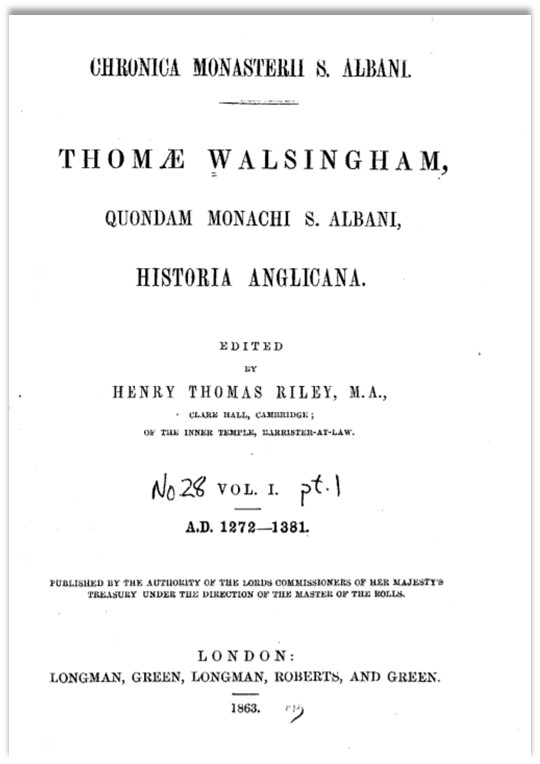
Public Domain: Thomæ Walsingham, quondam monachi s. Albani, Historia Agalicana, no. 28, Volume I, part 1
While men like Gaunt were being denied privileges and “rights”, by circumstance or coincidence, normally afforded to them, the Ricardian court also saw the radical and erratic transference of titles to men who would,under few circumstance in other Plantagenet courts, receive titles in such rapid succession. Such is the curious case of Robert de Vere, Earl of Oxford, as previously discussed and for many years during the first half of Richard’s reign one of his closest confidants was his own age. This would not go unnoticed by one, elder members of the court, and two, the chroniclers who could not resist writing about such relationships in a sollipstic though tabloid manner. As Walsingham recounts, of de Vere’s rapid accumulation of titles in 1386 from his ‘best friend’ Richard II:
Text within this block will maintain its original spacing when publishedVbi ne dominus rex parum fecisse uideretur, dominum Robertum de Veer, quandoque comitem Oxonie, set nuper in ultimo parliamento creatum marchionem Dublinie, ducem fecit Hibernie, facturus expost de duce regem si fortuna faueret; tantumafficiebatur eidem, tanum coluit et amauit eundem, non sine nota, prout fertur, familiaritatis obscene; submurmurantibus ceteris nobilibus et baronibus, ac indigne ferentibus tante promocionis appetitum in
Text within this block will maintain its original spacing when publishedShould when our lord the King not seemed to have done little, Lord Robert de Vere, at times the count of Oxford, not long ago created Marquis of Dublin in the Good Parliament. He was made Duke of Ireland, becoming just behind the king if Fortune should favor, all so much had the king had felt the same, so much he inhabited and loved him. not without note, a friendship close and obscene, by the soft murmurs from the other nobles and barons, noted by unworthy promotions. (Walsingham, 540)
From either side of the aristocracy’s slow crawl up or down the chain of being, the deficiencies of Richard’s court were patched up by the extent and intensity of the homosocial relationships that enveloped the court. Robert de Vere’s larger than life acquisition of titles via homosocial bequeathing from Richard II is entirely emblematic of the decadence that critics and chroniclers came to loathe the king for, while John of Gaunt, as a vestige from the Edwardian era, carried the baggage of hopes and dreams of the eternal crusade; the perpetual expansion of Christendom through material war and spiritual subjugation. Both Walsingham and Usk build together albeit separately a means for the chronicles to illustrate the abnormalities and dysfunctionalities of Richard’s court compared to his predecessors that lead to the homosocial expansions that further complicate, instead of resolve, the stability of masculinity in this era.
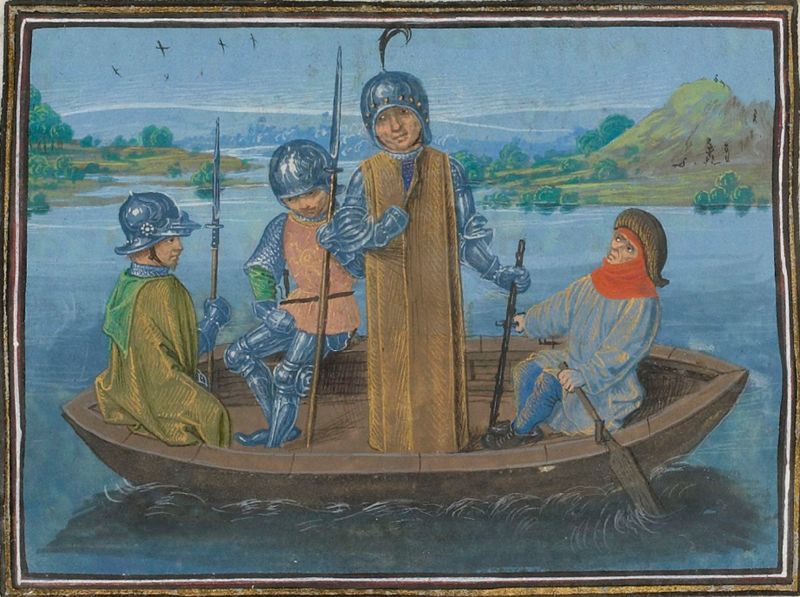
Public domain: Richard II's court favourite Robert de Vere fleeing Radcot Bridge after the 1387 battle; taken from the Gruthuse manuscript of Froissart's Chroniques (ca. 1475).
“Index to the Rolls Series.” Edited by Steven H. Silver, The Online Reference Book for Medieval Studies, ORB, 2001, https://the-orb.arlima.net/rolls.html. ↩
Saul, Nigel. “17. Richard: King and Man”. Richard II. Yale University Press, 1997, p. 461. ↩
Murray, Patrick. “Thomas Becket of Canterbury: Eight Hundred Years On.” Studies: An Irish Quarterly Review, vol. 59, no. 233, Irish Province of the Society of Jesus, 1970, pp. 68–80, http://www.jstor.org/stable/30088693. ↩
Saul, Nigel. “Humiliation and Constraint, 1386-7.” Richard II, Yale Univ. Press, New Haven, Conn. U.a., 1997, pp. 162–163. ↩
Ormrod, W. M. “Knights of Venus.” Medium Ævum, vol. 73, no. 2, 2004, p. 290., https://doi.org/10.2307/43630558. ↩
Walsingham, Thomas, et al. “De Discordia Inter Regem Et Ducem Lancastrie, Et Reditu De Scotland, In the Absence of the King the Scots Plunder England.” St Albans Chronicle 1376-1394, Chronica Maiora, vol. 1, Clarendon Press, Oxford , 2003, pp. 762–767. Oxford Medieval Texts. ↩