The Knight's Wail: Homosociality in King Richard II's Courts, Poetry, John of Gaunt, & Pan
The great goat god himself and Edward III's least favorite son
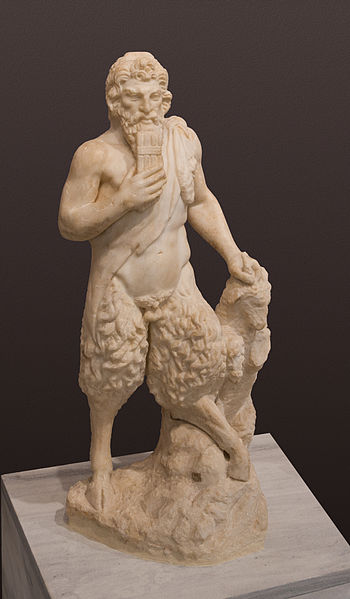
Public Domain: Opening title of “The Dreame of Chaucer”, commonly referred to as “The Book of the Duchess”, Geoffrey Chaucers first own work, which was written probably between 1368 and 1372; published 1532 in the first collected edition of Chaucer’s works, edited by William Thynne
The speaker observing the ‘“man in blak” (Chaucer, line 445) sitting under “an oke, an huge tree” (447) the speaker of The Book of the Duchess notices the countenance of grief and remarks:
I wente and stood right at his fete,
And grette him, but he spak noght,
But argued with his owne thoght,
And in his witte disputed faste
Why and how his lyf might laste;
Him thoughte his sorwes were so smerte
And lay so colde upon his herte;
So, through his sorwe and hevy thoght,
Made him that he ne herde me noght;
For he had wel nigh lost his minde,
Thogh Pan, that men clepeth god of kinde,
Were for his sorwes never so wrooth.
I went and stood right at his feet,
And greeted him, but he spoke not,
But he argued with his own thoughts,
And stuck in his head, disputing
why or how his life would then last;
He thought his sorrows were so strong
And lay like ice upon his heart;
Through his sorrow and heavy thought,
Made seem as though he heard me not,
By then he had well lost his mind,
Pan, whom men call God o’ Nature,
Never though so enraged by his sorrows.
(502-13, translation my own)
Across the courts of Edward III and Richard II, by accounts of the aforementioned chroniclers was there never such a man uncrowned who engaged so readily and thoroughly in the endeavors of the Christian knight and medieval statesman as Gaunt. Yet here, without lending to an entirely biographical reading, the Man in Black is nothing but a reflection of Gaunt is a man who is catatonic as he is vulnerable. Completely subsumed by sorrow, he wonders “[w]hy and how his lyf might laste” (506) and cannot initially respond to the speaker at all. By the standards of metaphor that Edward III was immortalized in the provided elegy, the interiority of the Man of Black is unrecognizable as one of a knight. His inhibited facilities not only get in the way of any semblance of knighthood and its usual haunts (such as interiority’s absence), but at large does not allow the Man of Black to readily engage with the world.
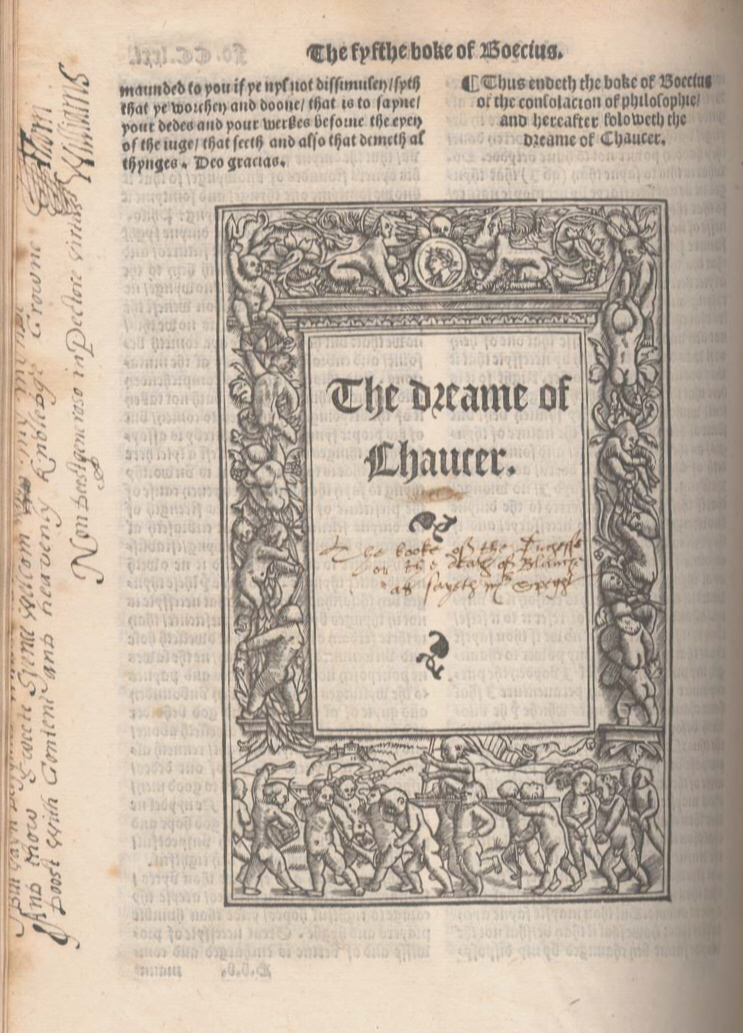
Creative Commons: CC0 1.0 Universal Public Domain Dedication: Roman statue of Pan, marble, from Argyroupoli (former Lappa), 2nd-century CE
The invocation of Pan is particularly significant as an unexpected, though poignant, foil to bounce the Man in Black’s presentation through. Though Chaucer cites him merely as the “god of kynde” (ie, nature), the sources involving Pan that Chaucer would at shorthand be familiar with would be not from Greek originals, but with Ovid’s Metamorphoses. Pan, as according to Ovid’s “Pan and Syrinx” is not simply a god of nature, but is displayed in overtly masculine attributes and sexual aggression1. Ovid’s less than flattering view of Pan, for such a multifaceted god from antiquity (not even always displayed as a male)2, if considered a source material, affects the impetus for such an invocation. Pan is offered up as a contrast — a larger than life goat-footed philanderer and masculine aspect of nature, to the Man in Black — a man brought to his wits’ ends in grief over the loss of his wife. Critical speculation around whether or not Chaucer had direct contact with the Auchinleck manuscript aside, folk superstitions around fairies, nature, and ‘sleeping under trees’ are all motifs in the Wife of Bath’s Tale3, as it is featured prominently in premonition of violence in the Auchinleck’s Sir Orfeo and Sir Degaré4. The tree which the Man in Black sits under is the locus from which the mores of knighthood and masculinity, the latter both from the localized Anglo-Norman/English context and the broader one from antiquity, and the results that grief produce is one of a catatonic and depressive state. The interiority is delivered to the reader indirectly, albeit indicative of the Man in Black’s engagement with his external conditions: “And in his witte disputed faste / Why and how his lyf might laste”, and this is precisely the sort of despair which angers Pan and the mores of masculinity. While Pan exists and survives in the forms of different “Panes” which do not all correspond to the contemporary framing of “toxic masculinity”, Chaucer’s Pan being derived from Ovid’s sources and brought into conversation with the Man in Black’s masculinity and grieving state is a powerful condemnation of it. Written in the waning years of Edward III’s reign, the disparities between masculinity and knighthood would only grow larger as the Ricardian era starts.
Chaucer’s (unfinished) magnum opus known to the world as The Canterbury Tales does not make any attempt to conceal the questions of the knight’s status and role in society, and in fact, is the first socio-political issue that the poem addresses. The Knight is not only the first character introduced in The General Prologue but also the first pilgrim to share a story with The Knight’s Tale. It should be noted as well that the urgency of placing The Knight’s Tale is not a coincidence of chronological introduction; the following tales’ order do not correlate with the order in which Chaucer introduces them, at least as observed by the Ellesmere manuscript from which I source my quotations. The Knight is not the same, spry knight one might find in a King Arthur story or an average Middle English romance such as Bevis or Sir Tristram in manuscripts from just a few decades earlier — Chaucer’s Knight has the marks of time and the anxieties of knighthood relative to his time written across his body.
He was a verray, parfit gentil knyght.
But for to tellen yow of his array,
His hors were goode, but he was nat gay.
Of fustian he wered a gypon
Al bismotered with his habergeon,
For he was late ycome from his viage,
And wente for to doon his pilgrymage.
He was verily a perfect, gentile knight
But to tell you of his array,
His horse was good, but he was not dressed gay,
He wore a tunic of composite cloth,
Besmoothered with his hauberk’s rust,
For he had lately come from his journey,
And went here for to do his pilgrimage
(72-8, translation my own)
Despite being a “parfit, gentil knyght”, Chaucer’s Knight is not dressed with any sort of shimmer, nor the towering intimidation exemplary of the Green Knight in Sir Gawain & The Green Knight roughly contemporaneous with The Canterbury Tales. Instead, the Knight is portrayed wearing a tunic of the tattered, composite cloth “fustian” — a pointed reference to the Knight’s affect value and class authenticity. In a comparative piece on textiles of the period between English ‘fustian’ versus its French counterpart ‘galimatias’, Roberts points out that “[...] in England ‘fustian’, literally coarse cloth made to look like velvet, became a variety of prose bordering on nonsense[...] The word ‘fustian’ thereby suggests passing off something of lesser value as something of higher value”5 (Roberts, 102). Beyond the sumptuary surface level of analysis (ie, sumptuary laws, garders, titles, etc), it is down to the textile itself that posits the Knight as a figure in decline, of an era gone by, and beside himself in parody.
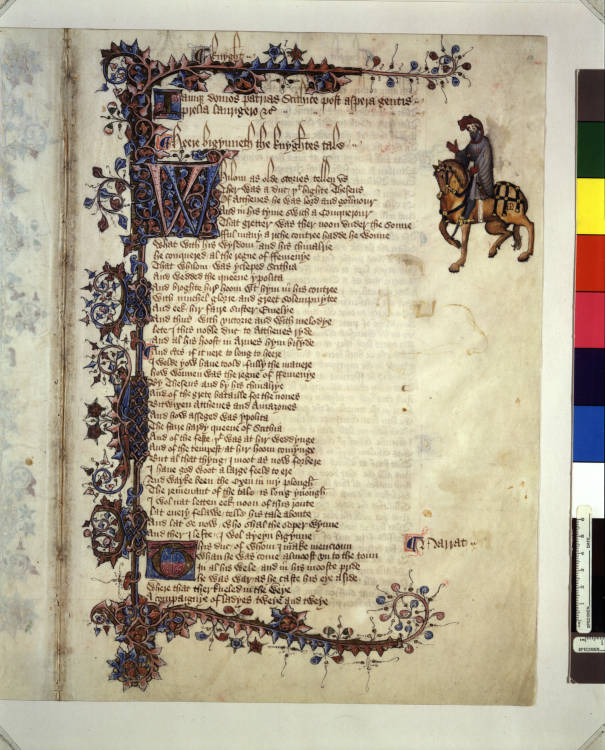
Courtesy: mssEL 26 C 9, Ellesmere Manuscript, f. 10r, The Knight’s Tale, The Huntington Library, San Marino, California.
Chaucer’s Knight, just like some of the most prominent men of the Ricardian era, fails to live to the generous expectations of the nearby past of the Crusades. The Knight is not only dressed the way he is, despite his long list of crusades and expeditions ranging from “alle nacions in Pruce; / In Lettow hadde he reysed and in Ruce” and “In Gernade at the seege eek hadde he be / Of Algezir, and riden in Belmarye / At Lyeys was he and at Satalye” (lines 53-4, 56-8), he is bereft of any real, tangible titles with neither The General Prologue nor The Knight’s Tale affording him one. In fact, the Knight sits in the minority of pilgrims in the Tales whose tale is not preceded by an individually tailored prologue, a group which also includes his Squire as well as the Physician. The Knight may have nothing else to offer the Squire but an apprenticeship or unpaid internship, as his titles or lands are never brought to light in the text, and certainly not any he won abroad. The John of Gaunt comparisons abound here, given all of Gaunt’s significant titles were actualized upon the instance of homosocial exchange, not by marriage or by battle. Though the Knight is the most well traveled pilgrim, in terms of his finances and landholdings he is one of the more modest. However, it is for that reason as well that it is hard to make the one-for-one comparison that the Knight is John of Gaunt; it is a harder leap of faith (or analysis) to draw than the Man in Black as John of Gaunt. Gaunt was by far one of the wealthiest men at home in his time6, the largest intersection that him and the Knight share would be their absence of a hard won title.
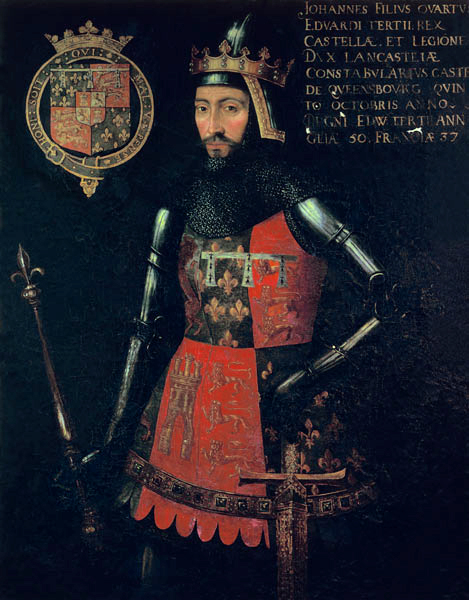
Anachronistic portrait of John of Gaunt, 1st Duke of Lancaster (1340-1399), Knight of the Garter, fourth but third surviving son of King Edward III of England. Property of his descendant the Duke of Beaufort, hanging at Badminton House, Gloucestershire. Portrait commissioned in about 1593 by Sir Edward Hoby (1560-1617) — maybe painted by Lucas Cornelisz de Kock (1495–1552)
Murgatroyd, P. “Ovid’s Syrinx.” The Classical Quarterly, vol. 51, no. 2, Cambridge University Press, 2001, pp. 620–23, http://www.jstor.org/stable/3556541. ↩
De Cicco, Mark. The Queer God Pan and His Children: A Myth Reborn 1860-1917. 2016. George Washington University, PhD dissertation, pp. 21. ↩
Silverstein, Theodore. “Wife of Bath and the Rhetoric of Enchantment; Or, How to Make a Hero See in the Dark.” Modern Philology, vol. 58, no. 3, University of Chicago Press, 1961, pp. 153–73, http://www.jstor.org/stable/434991. ↩
Hutton, Ronald. “The Making of the Early Modern British Fairy Tradition.” The Historical Journal, vol. 57, no. 4, Cambridge University Press, 2014, pp. 1135–56, http://www.jstor.org/stable/24531978. ↩
Roberts, Hugh. “Comparative Nonsense: French Galimatias and English Fustian.” Renaissance Studies, vol. 30, no. 1, Wiley, 2016, pp. 102–19, https://www.jstor.org/stable/26618840. ↩
Cox, Rory. “A Law of War? English Protection and Destruction of Ecclesiastical Property during the Fourteenth Century.” The English Historical Review, vol. 128, no. 535, Oxford University Press, 2013, pp. 1381–417, http://www.jstor.org/stable/24473892. ↩