Richard III & the Tower (XVI)
Hi everyone! Been a little behind on various writing projects and deadlines — I’m teaching a Shakespeare class as the sole instructor for the first time and its been taking up a lot of my spoons.
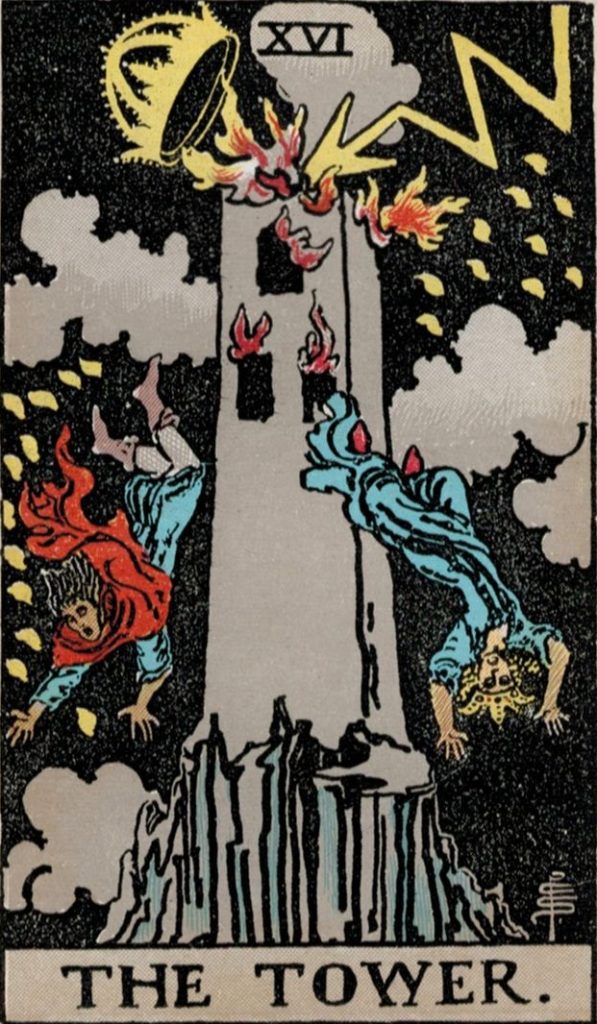
As a medievalist who came to the medieval from the renaissance (for those uninitiated, Shakespeare is not a medieval author), I’m frequently left with feeling of uncanniness and whiplash when I read texts like Richard III (c. 1592). The War of the Roses, the central geopolitical conflict of the play, is usually cited as the end of the English Middle Ages, and the start of the English Renaissance (decades ‘behind’ Italy). In our own age of dual houses competing for the throne here in the United States, I’ve been thinking about Richard III not only in my own usual academic interests of queerness, transness, and disability, but current events as well. There is one singular image that summarizes my thoughts on Richard III and 2024: the sixteenth card of the Major Arcana in tarot: The Tower.
The Tower (XVI) as portrayed in the Rider-Waite deck, c. 1909; public domain
There’s a few reasons that the Tower comes to mind in proximity to Richard III. To ground the discussion, let me open up with a quote from the late Rachel Pollack in Seventy-Eight Degrees of Wisdom (1980) that describes the immediate symbolism of the card, “some problems, illness or death of people close to us, economic problems in society, even natural disasters, such as storms - or lightning bolts - appear at the same time as personal problems, such coincidence shows again that life does indeed contain more than we can see in front of us.” It’s astrological concordances would be Mars, the planet of sex and aggression — a phonemic twin to Mars, the premier Roman god of war. Some tarot scholars will cite Uranus and Pluto as well for planetary influences — the planets of revolution and death/rebirth/underworld energy respectively. It is also worth acknowledging this as a ‘jumpscare’ card for many folks, along with Death (XIII) and The Devil (XV). Though frankly between the three, I am more weary when I see the Tower (XVI). It is the eschaton, collapse, the sky is falling, cue R.E.M’s “It’s the End of the World As We Know It (And I Feel Fine)”. I remember drawing this card when I, naively, asked my deck at the time what the outcome of the 2020 election would be.
But yet, even when the Tower (XVI) appears in our readings, life goes on. The Tower appears by name (kinda) in Act III of Richard III, as the Tower of London. A holdover from the Norman dynasty, the Tower is a staple of English history and frankly, a tourist trap. I went once as a teenager during a Model UN trip and had a blast being an obnoxious American Teenager (cue Ethel Cain). For a place that saw so much death and imprisonment, the vibes were up. In the play, the Duke of Gloucester and later King Richard conducts a lot of seedy business there — including its site of the murder of his kid nephews, Richard and Edward. It may be important to mention here that Shakespeare very likely did not get history right here — though the recent evidence doesn’t necessarily clean Richard of the charges, either. Acquittal at best (I’m rooting for you though, Richard and Philippa!). Nonetheless, the scenes at the Tower cement Richard III’s reign as much as it condemns it to a soon and ill-fated end. The ghost of his one-time king and two-time predecessor King Henry VI reminds Richard in a dream (nightmare) sequence that:
Text within this block will maintain its original spacing when published“When I was mortal, my anointed body
By thee was punchèd full of deadly holes.
Think on the Tower and me. Despair and die!Harry the Sixth bids thee despair and die." (V. iii. 132-5)
This also alludes to Richard’s murder of Henry in the Tower. While this is also not 100% historically verifiable either, it is all but certain that Duke Richard would have been at least present in the Tower at the time of Henry’s death. Death, at a micro and macro level then, is embodied in the waxing and waning of family feuds and their murders in the Tower. We may even see some parallel with Michel Foucault (RIP, you would’ve loved Charli XCX’s brat) and his concept of the panopticon from Discipline and Punish: “We are neither in the amphitheatre, nor on the stage, but in the panoptic machine, invested by its effects of power, which we bring to ourselves since we are part of its mechanism”. The Tower of London is the Tower (XVI) is the panopticon — a stage from which power is not only derived but denigrated as the onlookers observe on the power-passion-plays of politics.
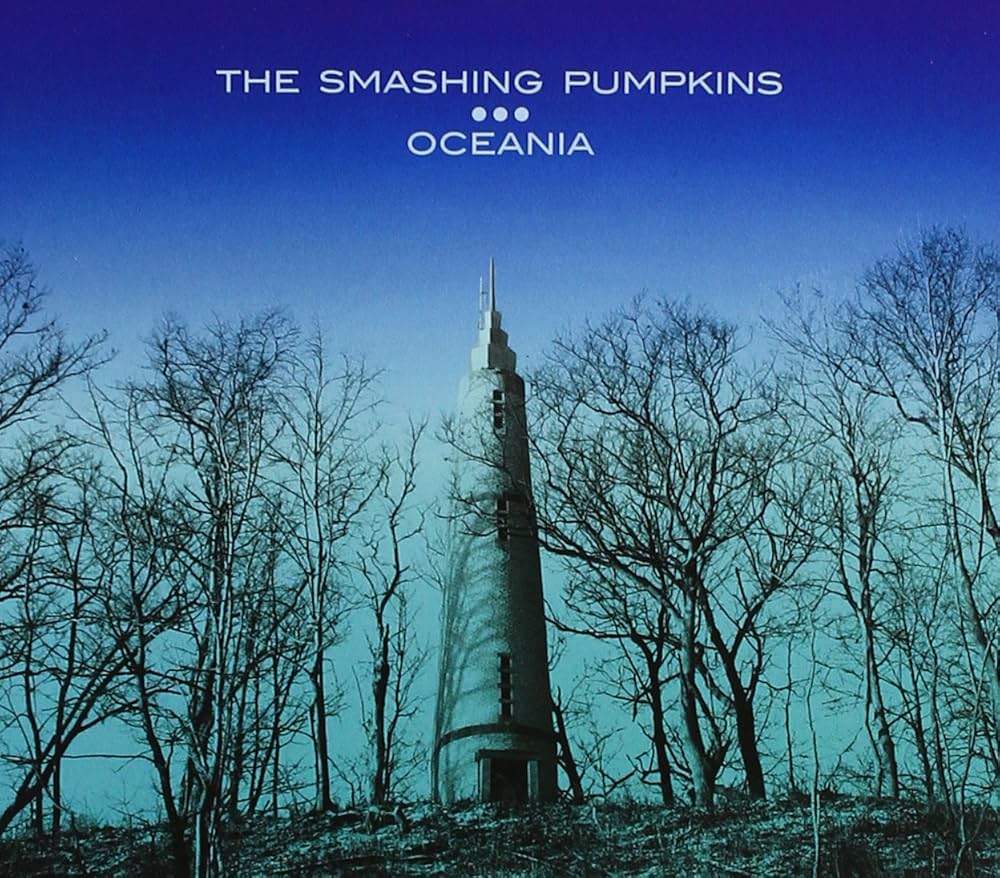
Text within this block will maintain its original spacing when published“Birds find the wind and wing
Rest in the shells I’ve designed
Run through the fields I’ve denied
And stroll upon the years I’m alive”
- “Panopticon”, The Smashing Pumpkins from Oceania; Martha’s Music 2012, under fair use
There is also a literary precedence, frankly, for the Tower in Richard III. From antiquity, Book IX or so of Virgil’s Æneid (c. 30-19 BCE) and its description of sieges between the Latin king Turnus and the Trojan refugee-warrior-leader-son of Venus Aeneas fight for the land that would become the Rome of Romulus and Remus. In turn, these scenes are inspired in full or in part by Roman annals such as those by Polybius, Livy, and Ennius re: the siege of Ambracia. Although a text from antiquity, among texts from that period the Æneid is unique in its influence on medieval literature and particularly the loosely, albeit contentiously, defined genre of medieval romance. It’s no surprise to see it at the climax of this influential if but, to take a term from Philip Knox’s introduction to his brilliant monograph The Romance of the Rose and the Making of Fourteenth-century English Literature (2022), ‘schizophrenic’ and sprawling medieval, dream vision poem. At the poem’s long climax (yes, it’s full of sex jokes), Venus and her allegorical compatriots seize the Tower where the Rose has been kept away from the allegorical protagonists Lover and Fair Welcome. To be clear, these ‘tower’ scenes provide us as reader chaos, violence, and death — but wish to impart a relatively happy ending. I don’t think that should be left ignored — even if the ethics of both these texts are questionable.
While the jury is still out on Richard III’s complete doings in and out of the Tower of London, the Tower regardless embodies a distant reading of the play that I believe is productive. Thanks for sticking along to my rambling!
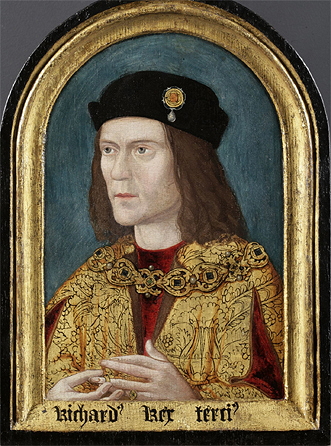
For good measure, my favorite portrait of Richard. Painted by Barthel ii (approximate date from tree-rings on panel), after a lost original, for the Paston family, owned by the Society of Antiquaries, London, since 1828. Public domain.